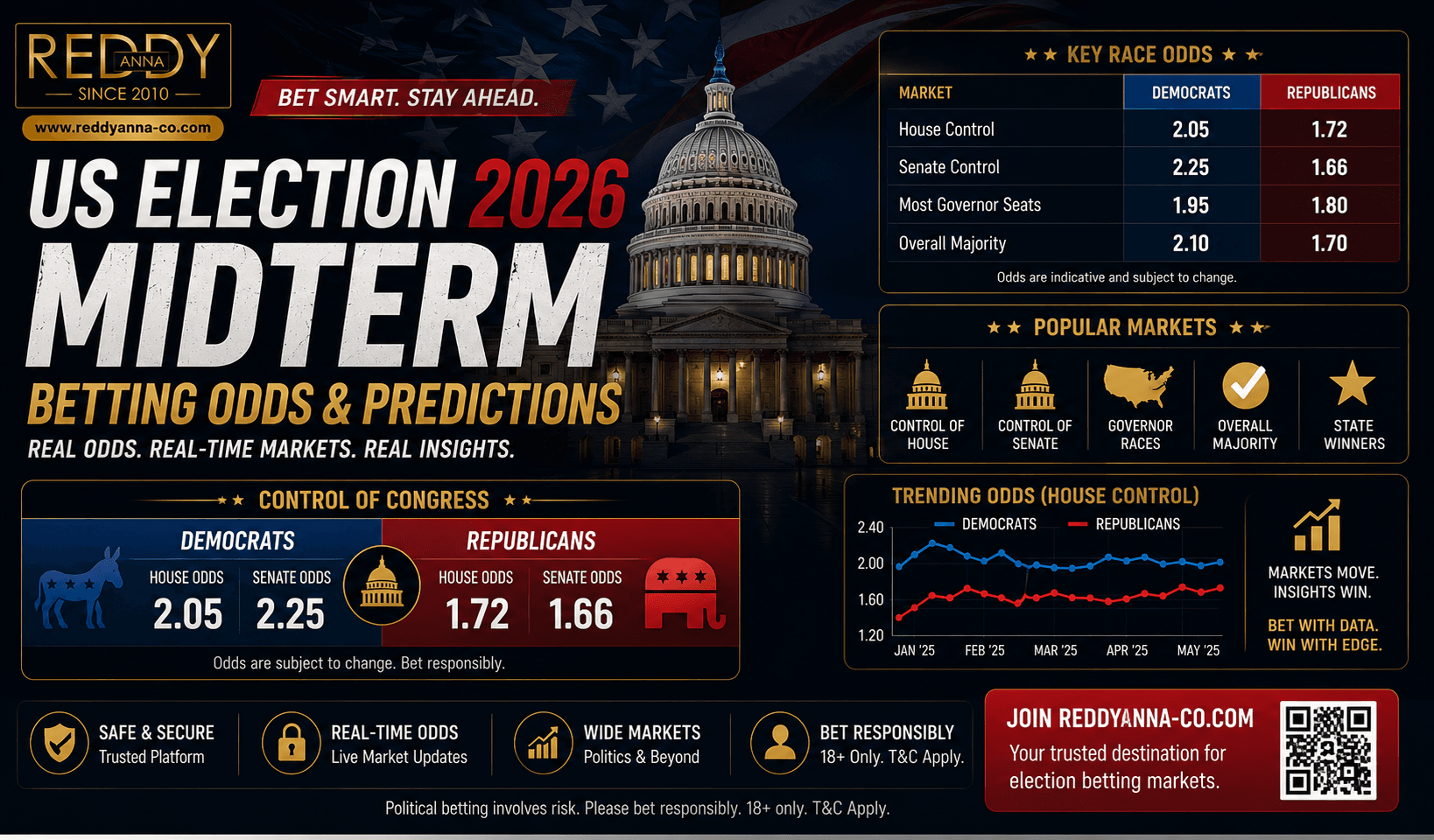
US election 2026 betting odds are already emerging as traders position for the most competitive midterm cycle in a decade. Unlike traditional polls that measure sentiment in isolation, 2026 US midterm election predictions through betting markets reveal where sophisticated money actually flows.
This guide unpacks House and Senate betting markets, examines congressional election odds 2026, and decodes what US political betting forecasts truly reveal about November's direction.
Whether analyzing US election prediction markets or seeking midterm election betting tips, understanding market mechanics beats guessing.
Why 2026 Midterms Break Betting Patterns: The Flip Dynamic
Historical trends suggest the party holding the presidency loses House seats, but 2026 presents anomalies. Current economic anxiety differs from the 2018 and 2022 cycles, yet polarization remains frozen.
2026 US midterm election predictions show Republicans favored in Senate races across competitive states, while House control remains genuine toss-up territory. Betting markets currently price a Republican Senate gain at 60-65% probability, a shift worth tracking as new data emerges.
The difference between early betting and election day frequently exceeds 10-15 percentage points because unexpected catalysts emerge. Economic recessions, major scandals, or unforeseen Supreme Court decisions rewrite narratives months before voters arrive.
House and Senate betting markets demonstrate this unpredictability by maintaining wide bid-ask spreads in 2026 races, signaling genuine uncertainty rather than settled outcomes.
Dissecting House and Senate Betting Markets: Distinct Betting Mechanics
House races concentrate funding in roughly 40-60 truly competitive districts, creating concentrated betting liquidity. Senate races spread across 34 seats in 2026, with only 8-12 offering genuine competitive odds.
This structural difference explains why congressional election odds 2026 on House seats fluctuate violently around individual events while Senate markets absorb shocks more gradually.
A single House district flipping involves neighborhood-level factors: local candidate quality, district-specific economic conditions, and micro-targeted campaign spending. Conversely, Senate races rest on state-wide dynamics affecting millions simultaneously.
US election 2026 betting odds reflect this by showing tighter clustering in Senate predictions and wider variance across House districts. Markets currently price 2-3 House seats swinging toward Republicans, though this figure shifted dramatically during recent political betting cycles.
Reading US Election Prediction Markets: The Hidden Stories
US political betting forecasts reveal patterns invisible to casual observers by showing where professionals actually allocate capital. When betting markets price a Senate race at -250 despite polls showing a tie, savvy traders likely possess superior ground intelligence about turnout models or candidate vulnerabilities.
Early 2026 data shows partisan lean matching 2020 boundaries, suggesting minimal seat movement in both chambers. Yet market volatility around specific states signals that traders expect realignment within existing maps.
US election prediction markets price the Arizona Senate race at near-even odds while projecting similar numbers nationwide, indicating bettors believe local dynamics matter more than the national environment. Pennsylvania, Wisconsin, and Nevada emerge as swing magnets for concentrated betting capital.
Strategic Positioning: Midterm Election Betting Tips That Matter
Professional bettors position for 2026 by identifying races where betting odds lag underlying fundamentals. Midterm election betting tips emphasize tracking district-by-district redistricting effects because many competitive races emerged from new boundaries, creating unfamiliar electoral math.
Candidates navigating redrawn districts face learning curves reflected incompletely in betting odds.
Secondary markets betting on primary outcomes often reveal candidate viability months before general election odds stabilize. 2026 US midterm election predictions incorporating primary chaos show more volatility than general election markets because nominee identity remains unsettled.
Smart bettors exploit this inefficiency by identifying likely nominees before wider markets price them. Campaign spending patterns matter too: candidates attracting substantial early funding signal competitive races ahead, often before public polling captures momentum shifts.
Final Thoughts: Capitalizing on 2026 Midterm Prediction Opportunities
US election 2026 betting odds present opportunities precisely because uncertainty genuinely exists, rather than markets mispricing settled races. 2026 US midterm election predictions through betting channels provide superior forecasts compared to single-point polls because thousands of participants stake real money on accuracy.
Understanding House and Senate betting markets' mechanics transforms how analysts evaluate congressional outcomes.
US political online betting forecasts will shift dramatically as campaigns intensify and genuine voter contact begins. Early markets currently reflect establishment expectations more than voter sentiment because grassroots movements haven't mobilized.
Congressional election odds 2026 will widen considerably once primary races conclude because candidates vary enormously in quality and campaign competence. Professional analysts integrating
US election prediction markets data alongside internal polling consistently outpredict traditional forecasters, making midterm election betting tips invaluable for serious observers. Whether tracking Senate control or House seats, prediction markets provide real-time collective intelligence too valuable to ignore.