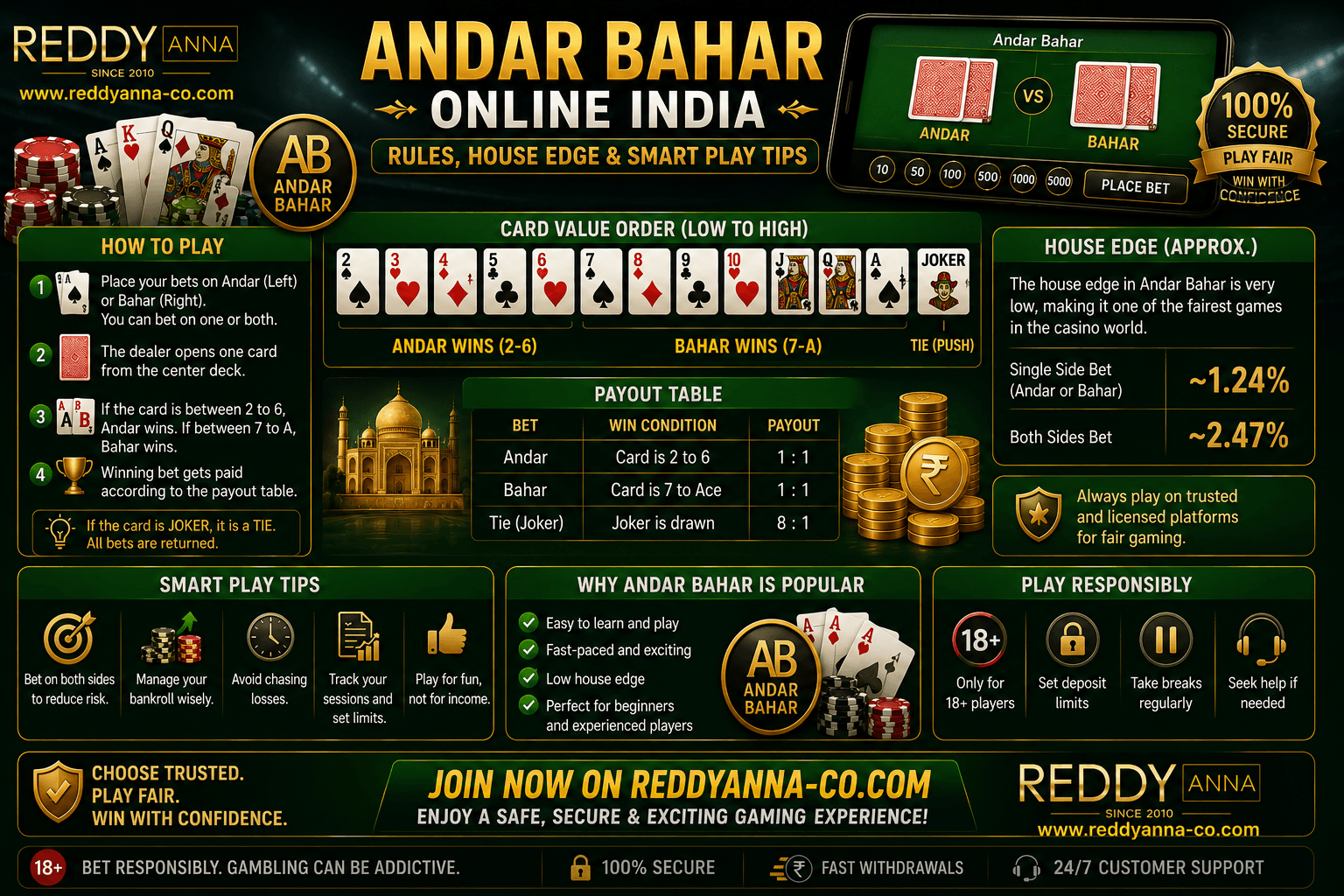
You sit down, a single card is placed face-up in the center of the table, and your only job is to predict which side—Andar (inside) or Bahar (outside)—will receive a matching card first. That is it. No complicated hand rankings to memorize, no bluffing, no multiple betting rounds to navigate. Just a straightforward guess between two options.
And yet, if you ask seasoned gamblers about this game, many of them will tell you it is deceptively nuanced. Not because the rules are complicated, but because the simplicity of the game hides a few mathematical realities that the average player completely misses. Miss those realities consistently, and the game quietly takes your money in ways you will not immediately connect to any single bad decision.
This article is about playing Andar Bahar well. Not just understanding the rules, which takes about three minutes, but understanding the structure underneath the game—what the house edge actually means in real money terms, why certain bets are better than others, and how to approach online Andar Bahar in India with the kind of clarity that separates recreational players from informed ones.
Where Andar Bahar Comes From
Before going into the mechanics, it is worth knowing where this game originated, because the context matters.
Andar Bahar is a traditional Indian card game that is believed to have originated in Bangalore, Karnataka. It has been played for generations in homes across South India under various regional names. Katti is one of the more common alternative names. In some parts of the country, the game is called simply "in and out," which is a direct translation of what Andar Bahar means.
Unlike Teen Patti or Rummy, which have documented connections to European card games, Andar Bahar appears to be a genuinely indigenous Indian game. It has always been social and accessible — you do not need any special knowledge to join a round, which is probably why it spread so widely across regions and class lines.
The online version preserves that accessibility while adding elements that matter to a serious player: consistent rules, published return-to-player rates, and, in live dealer formats, real-time gameplay with an actual human dealer. When Indian online platforms brought Andar Bahar into their game libraries, they were not introducing something foreign. They were digitizing something that millions of people already knew.
How to Play — The Complete Picture
The rules of Andar Bahar are genuinely simple, but covering them completely matters because online versions sometimes include side bets and additional mechanics that build on the core game.
The setup:
A standard 52-card deck is used. Suits are irrelevant to the outcome. Only the rank of the card matters.
The game card (Joker card):
At the start of each round, the dealer draws a single card and places it face up in the center. This is variously called the game card, the trump card, or simply the middle card. Every subsequent decision in the round revolves around this card.
Andar and Bahar:
Two positions are marked on the table. Andar is traditionally on the dealer's left, Bahar on the right. Before any cards are dealt to these positions, you place your bet on whichever side you believe will receive a card matching the rank of the game card first. If the game card is a 7, you are betting on whether a 7 will appear on the Andar side or the Bahar side before the other.
The deal:
The dealer begins drawing cards alternately to the Andar and Bahar positions. In most versions, the first card goes to Andar. Cards continue being dealt until a match appears. Whichever side receives the matching rank first wins. If you bet on that side, you win.
Payouts:
In the standard version, a correct bet on either Andar or Bahar pays even money (1:1). However, some platforms adjust this. Because the first card is dealt to Andar, Bahar is considered to have a slight statistical disadvantage in certain rule versions, and some casinos compensate by offering slightly better payouts on Bahar wins. More on this shortly.
The side bets:
Online versions of Andar Bahar commonly offer additional betting options before the game card is revealed. You might bet on the suit or rank of the game card, on how many cards will be dealt before a match appears, or on whether the game card will be red or black. These side bets are the ones that carry higher house edges, and we will address them in the strategy section.
That is essentially the full game. If you know those mechanics, you can sit down at any Andar Bahar table in India and follow what is happening without confusion.
Online vs. Live Dealer Andar Bahar
The online version of Andar Bahar in India comes in two main formats, and they are meaningfully different experiences.
RNG (Random Number Generator) Andar Bahar uses software to simulate the card draw. There is no physical deck, no dealer, and the outcome of each round is determined by an algorithm that is certified to produce genuinely random results. These tables tend to run faster, allow lower minimum bets, and are available around the clock without any wait time. The tradeoff is atmosphere — it feels more like a slot machine than a card game.
Live Dealer Andar Bahar streams real-time video of a human dealer using a physical deck of cards in a studio setting. Indian platforms have invested significantly in this format, with dealers who speak Hindi and English, professional studio setups with good lighting and multiple camera angles, and gameplay that feels much closer to sitting at a real table. The pace is slower, the minimum bets tend to be higher, and there is sometimes a waiting period to join a table during peak hours.
For players who want authenticity, live dealer Andar Bahar is worth the slightly higher buy-in. For players who want volume and prefer grinding many rounds in a short session, RNG tables are more practical.
The house edge and payout structures are the same across both formats on reputable platforms, so the choice between them is mostly about personal preference rather than strategic advantage.
The House Edge — What It Actually Means for Your Money
This is the part of the article that most game guides skip over or explain too briefly, which is frustrating because it is arguably the most important thing a player can understand.
The house edge is the mathematical advantage the casino holds over the player on any given bet. It is expressed as a percentage of each bet that the casino expects to retain over a large number of rounds. It is not a guarantee that you will lose that exact amount on any single session, but over time, it is the mechanism through which the casino makes money.
In standard Andar Bahar, the house edge sits at approximately 2.15% on an Andar bet and around 3% on a Bahar bet. These numbers shift depending on the specific ruleset being used, particularly around which side receives the first card and how the payouts are structured.
Here is what that means in practice
If you place a bet of 100 rupees on Andar in every single round, and you play 100 rounds, you are wagering 10,000 rupees total. With a house edge of 2.15%, the casino's expected profit from your session is approximately 215 rupees. That does not mean you will end the session exactly 215 rupees down — you might be up, you might be down significantly more. What it means is that if you played this exact session an infinite number of times, your average loss per session would converge toward 215 rupees.
That is a relatively low house edge compared to many casino games. Slot machines typically run house edges between 5% and 15%. American roulette sits at 5.26%. European roulette is at 2.7%. Andar Bahar's house edge on the main bet is competitive with some of the better bets in the casino, though not quite as favorable as the best blackjack plays or baccarat banker bets.
Where it gets more expensive is the side bets
Side bets in online Andar Bahar, like predicting the rank of the game card, the suit, or the number of cards before a match, carry significantly higher house edges. Depending on the platform and specific bet, you might be looking at house edges of 6%, 8%, or even higher on these secondary wagers. They feel excited because they offer bigger payouts, but mathematically, they are much worse for the player over time.
A player who bets the main Andar or Bahar position consistently and avoids side bets is operating at a dramatically lower expected loss rate than a player who mixes in frequent side bets. This is not a minor difference. Over a long session, the gap in expected outcomes between these two approaches can be substantial.
The First Card Rule and Why It Creates an Asymmetry
Here is a specific mechanic that affects the mathematics of Andar Bahar and that very few players bother to think about.
In most versions of the game, the dealer begins dealing to the Andar side first. This single rule creates an asymmetry between the two bets. Because Andar gets the first card, it has a marginally higher probability of receiving the matching card than Bahar in any given round.
The exact math depends on the number of remaining cards in the deck at any given point, but the general principle is this: Andar wins slightly more often than 50% of the time, and Bahar wins slightly less often than 50% of the time, because Andar has one extra opportunity to match before Bahar gets another chance.
Casinos account for this in different ways. Some simply accept the asymmetry and charge a slightly lower house edge on Andar bets compared to Bahar bets. Others offer a slight payout premium on Bahar — something like 0.9:1 on Andar and 1:1 on Bahar, or vice versa — to mathematically compensate for the first-card advantage.
The implication for players is straightforward: before sitting down at any Andar Bahar table online, check the specific payout structure being used. If both sides pay 1:1 and the first card always goes to Andar, then Andar is the mathematically better bet. If the platform compensates for this through adjusted payouts, the advantage disappears, and both bets become roughly equivalent.
This is the kind of detail that is easy to overlook but worth ten minutes of your time before you start playing.
Card Counting in Andar Bahar — Is It Worth Trying?
Because Andar Bahar is played with a standard deck and the cards are visible as they are dealt, some players have asked whether card counting is useful here in the same way it is used in blackjack.
The honest answer is: marginally, and only in specific circumstances.
In a live dealer game where the deck is not reshuffled between rounds, information does accumulate as cards are dealt. If you know the game card's rank and you know how many cards of that rank have already been dealt this deck, you can make a rough probabilistic assessment of how many matching cards remain and how likely it is that the next few draws will hit.
In practice, this kind of tracking is extremely difficult to do in real time while also managing your bets, and the informational edge it provides is small enough that most players would not execute it accurately enough to benefit from it. Professional blackjack card counters spend months practicing the skill. Applying a similar level of discipline to Andar Bahar would require comparable commitment for a much smaller potential edge.
For recreational players, card counting in Andar Bahar is not a practical strategy. The game moves quickly, the edge from any counting approach is thin, and the mental energy required is better directed elsewhere. What matters more is understanding the house edge structure and making sound decisions about which bets to place.
Practical Strategy for Online Play
Given everything above, here is what a sound strategy actually looks like in online Andar Bahar.
Stick to the main bet. The Andar and Bahar bets carry the lowest house edges available at the table. Side bets are entertaining diversions, but they cost significantly more over time. If your goal is to extend your session and minimize losses, the main bet is where you want your money.
Understand the payout structure before betting online. Check whether the table pays equal odds on both sides or uses adjusted payouts to account for the first-card advantage. This takes thirty seconds and directly affects which side has the better expected value.
Set a session budget and hold to it. This sounds obvious, but it is consistently the most violated principle in online gambling of any kind. Before you start, decide the maximum you are willing to lose in that session. Once you hit that number, stop. Not after one more round. Not after trying to recover. Stop.
Do not chase losses. Andar Bahar is a fast game online, and the temptation after a run of losses is to increase bet sizes to recover ground quickly. This is statistically the worst response to a losing streak. The house edge on the next round is identical to the house edge on every previous round. Betting more does not change your expected outcome — it only increases your potential losses.
Use low-stakes tables to get comfortable first. Many online platforms offer Andar Bahar at bet sizes starting from very small amounts. If you are new to the online version or trying a new platform, starting at the lowest available stakes while you get familiar with the interface and pace is smart risk management.
Pay attention to deck penetration in live games. In live dealer Andar Bahar, notice whether the dealer shuffles after every round or plays through a significant portion of the deck. Deeper deck penetration means more information is available across rounds, which marginally improves your ability to make informed bets — though as discussed, the practical impact of this is limited for most players.
Avoid progressive betting systems. Martingale, Fibonacci, and Labouchere — these systems are popular in betting communities and genuinely do not change the mathematical house edge over time. What they do is restructure risk in ways that can produce short-term wins followed by catastrophic losses when a long losing streak hits. No betting system has ever turned a negative expected value game into a positive one.
Choosing the Right Platform in India
The Indian online gaming market has grown significantly, and Andar Bahar is available on many platforms. Not all of them are equal, and the differences matter.
Return-to-Player (RTP) rates matter. RTP is the inverse of the house edge. A house edge of 2.15% corresponds to an RTP of 97.85%. Reputable platforms publish their RTP rates, and many have these figures independently audited. Look for platforms that are transparent about this. If a platform does not publish RTPs and cannot tell you the house edge on their Andar Bahar tables, that is a warning sign.
Look for live dealer options with an Indian context. Platforms that have invested in Hindi-speaking dealers, India-specific game variations, and culturally familiar settings tend to offer a better experience for Indian players. This is not just about comfort — it often signals that the platform is genuinely built for the Indian market rather than adapted from a generic international template.
Payment methods and withdrawal speed matter. The practical side of online gaming is often undervalued until something goes wrong. Platforms that support UPI, Paytm, and other India-specific payment systems are more convenient, and platforms with clear withdrawal timelines and reasonable processing speeds indicate operational integrity.
Customer support availability. For any platform you plan to play on seriously, test the customer support before you need it. Ask a question through whatever channel they offer and see how quickly and usefully they respond. This is basic due diligence that most players skip.
The Psychology of a Game This Simple
One of the underappreciated challenges of playing Andar Bahar is specifically its simplicity. Because there is no skill expression in the basic game — you are choosing between two options each round — players can fall into a false sense of pattern recognition. You might notice that Andar has won the last four rounds and feel convinced that Bahar is "due." This is called the gambler's fallacy, and it is one of the most reliably wrong intuitions in all of probability.
Each round of Andar Bahar is independent. The outcome of the last round carries no information about the next round's outcome, assuming the deck is being reshuffled. The cards have no memory. The game has no momentum. If Andar has won ten rounds in a row, the probability of each side winning the next round is the same as it was before those ten rounds happened.
This sounds simple. Most people reading it will nod and agree. And then many of those same people will still find themselves influenced by streaks during actual play, because our brains are pattern-seeking machines that were not designed for statistically independent events. Knowing about the gambler's fallacy and being immune to it are different things. The best protection against it is to make a rule before you start: your bet selection is determined by payout structure and house edge analysis, not by what happened in the last several rounds.
What Experienced Players Actually Do Differently
If you watch someone who has played a lot of online Andar Bahar compared to someone new to it, the difference is not in their ability to pick winners—nobody can predict random outcomes better than chance. The difference is in what they do around the game.
Experienced players set time limits, not just money limits. Playing for three hours straight leads to worse decisions than playing for one focused hour, regardless of how the session is going.
They treat wins with the same discipline as losses. Winning a significant amount early in a session and then giving it all back because the session "still has time left" is as common a mistake of chasing losses. Setting a win target and stopping is as valid as setting a loss limit and stopping.
They choose their tables deliberately. Stake levels, payout structures, live versus RNG, minimum and maximum bet sizes — these decisions are made before sitting down, not after.
They understand that variance is not a strategy. Over a short session, anything can happen. A player can ignore all sound strategy and run hot. A player can do everything right and lose steadily. Variance is real, and it is large in a game with a binary outcome. Evaluating your decisions based on outcomes rather than the quality of the decision itself is a mistake.
Final Thought
Andar Bahar is one of the most honest games in the online casino landscape. The rules are simple, the mathematics are transparent, and the house edge on the main bet is genuinely reasonable compared to many alternatives. There is no hidden complexity designed to confuse you, no elaborate bonus structure designed to obscure the true odds.
What the game asks of you is not strategic genius. It asks for clarity about what you are doing and why. It asks for the discipline to stick to the bets with better expected value, to set limits and honor them, and to engage with the game for what it actually is rather than what you might wish it to be.
The players who enjoy Andar Bahar over the long run are the ones who go in with realistic expectations, a clear understanding of the house edge and what it means for their bankroll, and the self-awareness to make decisions based on math rather than feeling.
That combination does not guarantee winning sessions. Nothing does in a game with a house edge. But it guarantees that when you sit down to play, you are playing as intelligently as the game allows — and over time, that makes every difference.