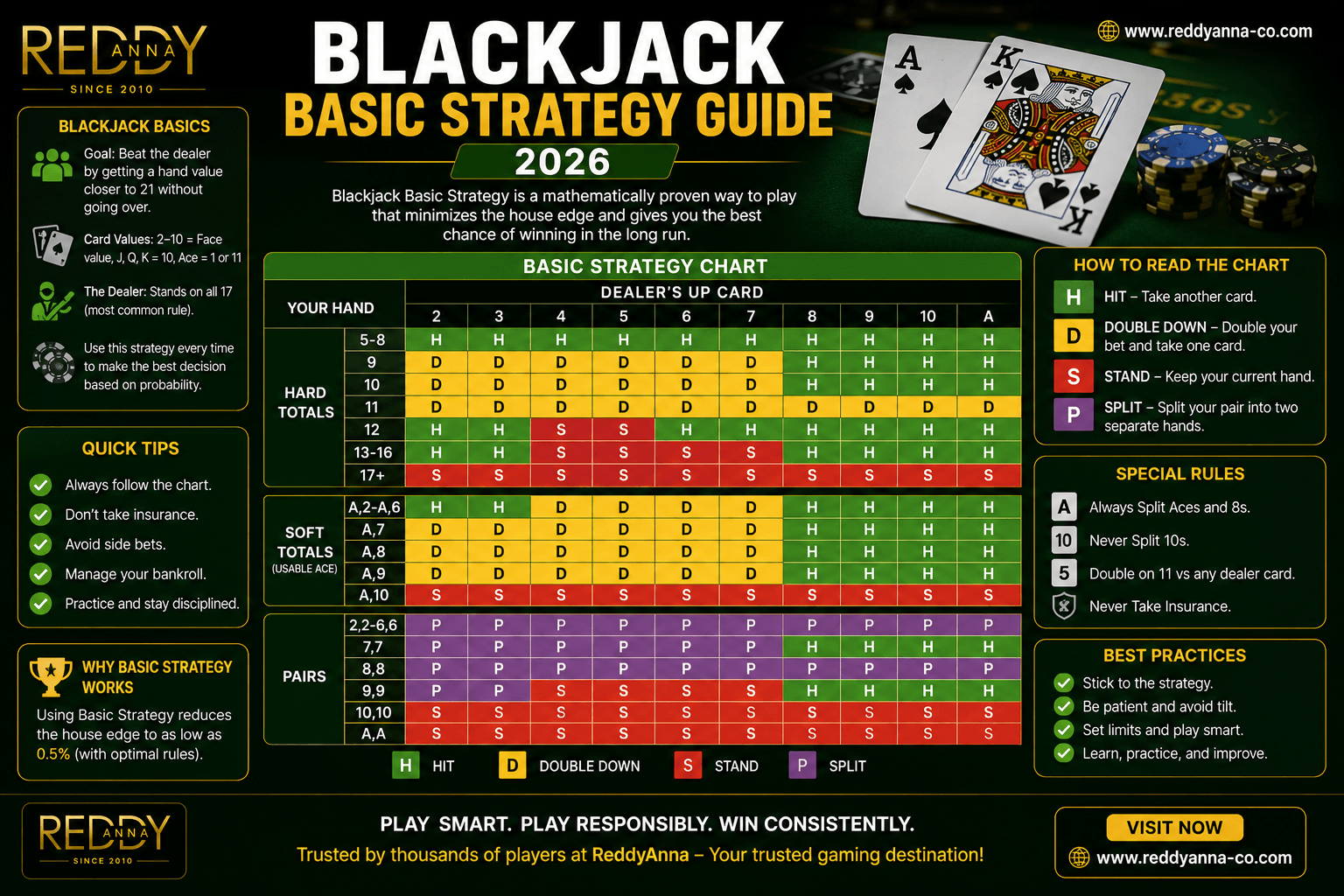
Blackjack is the only casino game where a player's decisions during each hand directly change the expected outcome. Not feelings or hunches. Actual mathematical decisions that either work with the probabilities or against them. Blackjack basic strategy is what those correct decisions look like written down, one situation at a time. Applied consistently, it reduces the house edge from around 2% on a standard game to approximately 0.5%. That's not zero. The house still has an edge. But 0.5% is the best a player can get in any live casino game without counting cards. This guide covers every major decision category with specific guidance on what to do and why.
Key Takeaways:
Blackjack basic strategy reduces house edge from approximately 2% to around 0.5% when applied correctly
Every decision is based on two pieces of information: the player's total and the dealer's visible upcard
Hard hands (no ace or ace as 1) and soft hands (ace as 11) follow different rules
Always split Aces and 8s. Never split 10s or 5s
Never take insurance. It carries approximately a 7% house edge
Choosing 3:2 natural blackjack tables over 6:5 is the single most impactful table selection decision
ReddyAnna carries live blackjack from multiple providers with real dealers
Blackjack Rules and Strategy: How the Game Actually Works
Two decisions feed every blackjack rule and strategy choice: what the player holds and what the dealer shows.
The goal is to beat the dealer's total without going over 21. Cards two through ten are worth face value. Ace is worth 11 or 1, whichever helps the hand. Jack, Queen, King are all worth ten.
The player gets two cards face up. Dealer gets two cards, one visible and one face down. The dealer's visible card is the upcard. It tells the player a lot about what's likely hiding underneath.
The dealer always plays by fixed rules. Must hit until reaching 17 or above. No choice in it. This predictability is exactly what blackjack basic strategy uses to determine the correct player decision for every situation.
Dealer Upcard Reading in the Blackjack Strategy Guide
The blackjack strategy guide concept of dealer "bust cards" drives most strategy decisions.
Dealer upcards of 2, 3, 4, 5, and 6 are weak. The dealer already has a hidden card underneath. With a weak upcard visible, there's a meaningful probability the dealer will be forced to hit into a bust. Players should be less aggressive in hitting and let the dealer potentially self-destruct.
Dealer upcards of 7, 8, 9, 10, and Ace are strong. The dealer likely has a strong hand underneath. Players need to take more risks to beat a probable dealer total in the 17 to 21 range.
This upcard classification drives almost every hit, stand, and double decision in the game.
Hard Hand Decisions in Blackjack Basic Strategy
A hard hand contains no ace or an ace that must count as 1 to avoid busting.
Hard 8 or below. Hit always. Can't bust on a single hit, and the total needs improvement regardless of what the dealer shows.
Hard 9. Double against dealer 3, 4, 5, or 6 (the weak upcards). Hit against everything else.
Hard 10 or 11. Double against most dealer upcards. Hard 11 is one of the best doubling hands available. Hard 10 doubles against everything except dealer Ace or ten-value card.
Hard 12 through 16. This group is where most beginner mistakes happen. Against dealer 2 through 6, stand and let the dealer potentially bust. Against dealer 7 through Ace, hit. The hand is weak, but hitting is better than standing against a dealer likely to finish strong.
Hard 17 and above. Stand. Always. Hitting 17 risks busting into a loss from a position that already beats many dealer outcomes.
Soft Hand Decisions in the Blackjack Strategy Guide
Soft hands contain an ace counting as 11. They can't bust on one hit because the ace simply switches from 11 to 1 if the total would exceed 21.
Soft 13 through 15 (Ace-2, Ace-3, Ace-4). Hit against most dealer upcards. Double against dealer 5 or 6 where the doubling opportunity is strongest.
Soft 16 or 17 (Ace-5, Ace-6). Double against dealer 3 through 6. Hit against everything else.
Soft 18 (Ace-7). The most commonly misplayed soft hand. Against dealer 2 through 6, double if allowed or stand. Against dealer 7 or 8, stand. Against dealer 9, 10, or Ace, hit. Standing on soft 18 against a dealer ten is wrong. The dealer likely has 17 to 21 underneath, and soft 18 needs improvement against that range.
Soft 19 or 20. Stand always. The hand is strong enough that no improvement attempt makes mathematical sense.
Splitting in How to Play Blackjack Correctly
How to play blackjack correctly requires knowing the splitting rules cold because most beginner mistakes happen here.
Always split Aces. A pair of aces totals 12, which is a weak hand. Two separate hands starting from Ace each have the potential to reach 21. Always split.
Always split 8s. A pair of 8s totals 16, the worst hand in blackjack. Standing loses to most dealer totals. Hitting busts frequently. Two hands starting from 8 each have better expected outcomes than playing the combined 16.
Never split 10s. A total of 20 wins most of the time. Splitting gives up a near-certain winner for two uncertain hands.
Never split 5s. Two 5s total 10, which is a strong doubling hand. Splitting turns one strong position into two weak positions starting from 5.
2s, 3s, 7s split against dealer 2 through 7. 4s split against dealer 5 or 6 only. 6s split against dealer 2 through 6. 9s split against dealer 2 through 6 and 8 or 9, but stand against dealer 7, 10, or Ace.
Blackjack Tips for Beginners: The Rules That Save the Most Money
Blackjack tips for beginners that have the biggest financial impact, in order.
Never take insurance. The insurance bet is offered when the dealer shows an Ace. Pays 2:1 if the dealer has blackjack. House edge on insurance is approximately 7%. No version of basic strategy recommends it. Ever.
Choose 3:2 tables only. A natural blackjack (Ace plus a ten-value card on the first two cards) should pay 3:2. Some tables pay 6:5 instead. That single rule change adds approximately 1.4% to the house edge. Playing on a 6:5 table while applying perfect basic strategy produces roughly the same house edge as playing basic strategy on a 3:2 table badly. Find the 3:2 table.
Use surrender when available. Late surrender allows folding a bad hand for half the stake after the dealer checks for blackjack. Surrender hard 16 against dealer 9, 10, or Ace. Surrender hard 15 against dealer 10. These are expensive positions to play through.
ReddyAnna for Live Blackjack in India
ReddyAnna as a trusted online betting site carries live blackjack from multiple providers with various rule sets including standard multi-deck games. Different table variants with different rule configurations run simultaneously, giving players the option to find 3:2 natural blackjack tables with surrender options.
UPI deposits clear in 60 seconds. IMPS withdrawals average 32 minutes. For structured blackjack sessions with clear budgets and win targets, fast payment access means starting and ending sessions without delays.
Final Thoughts
Blackjack basic strategy is the clearest and most directly applicable edge reduction available in any live casino game. Learning it takes an hour. Applying it correctly reduces the house edge to 0.5%. This blackjack strategy guide covers hard hands, soft hands, splitting, insurance avoidance, and table selection. Blackjack tips for beginners that produce the most immediate improvement: never take insurance, find 3:2 tables, always split Aces and 8s, never split 10s or 5s, and stand on hard 12 through 16 when the dealer shows a weak upcard.