There's a moment in live cricket betting that every bettor knows intimately. You placed a bet on India to win a T20 match. They're cruising at 160 for 2 with four overs left, needing 24 runs. The cash-out button on your screen is glowing with a number that's significantly better than your original stake. Your finger hovers. Your brain runs the calculation. And then the match takes one of those turns that cricket specializes in, two wickets in an over; suddenly the required rate is climbing, and the cash-out value you could have taken two minutes ago is evaporating in real time.
That decision point, the moment between cashing out and letting your bet ride, is one of the most genuinely complex micro-decisions in sports betting. It's not just about math. It's about psychology, risk tolerance, the specific dynamics of the sport you're watching, and a clear-eyed understanding of what the sportsbook is actually offering you when they display that number.
This guide is going to break all of that down, honestly. Not to tell you that cashing out is always good or always bad, because neither of those things is true. Instead, to give you the framework to make that decision well every single time you face it.
What Is Cash Out and Why Sportsbooks Promote It
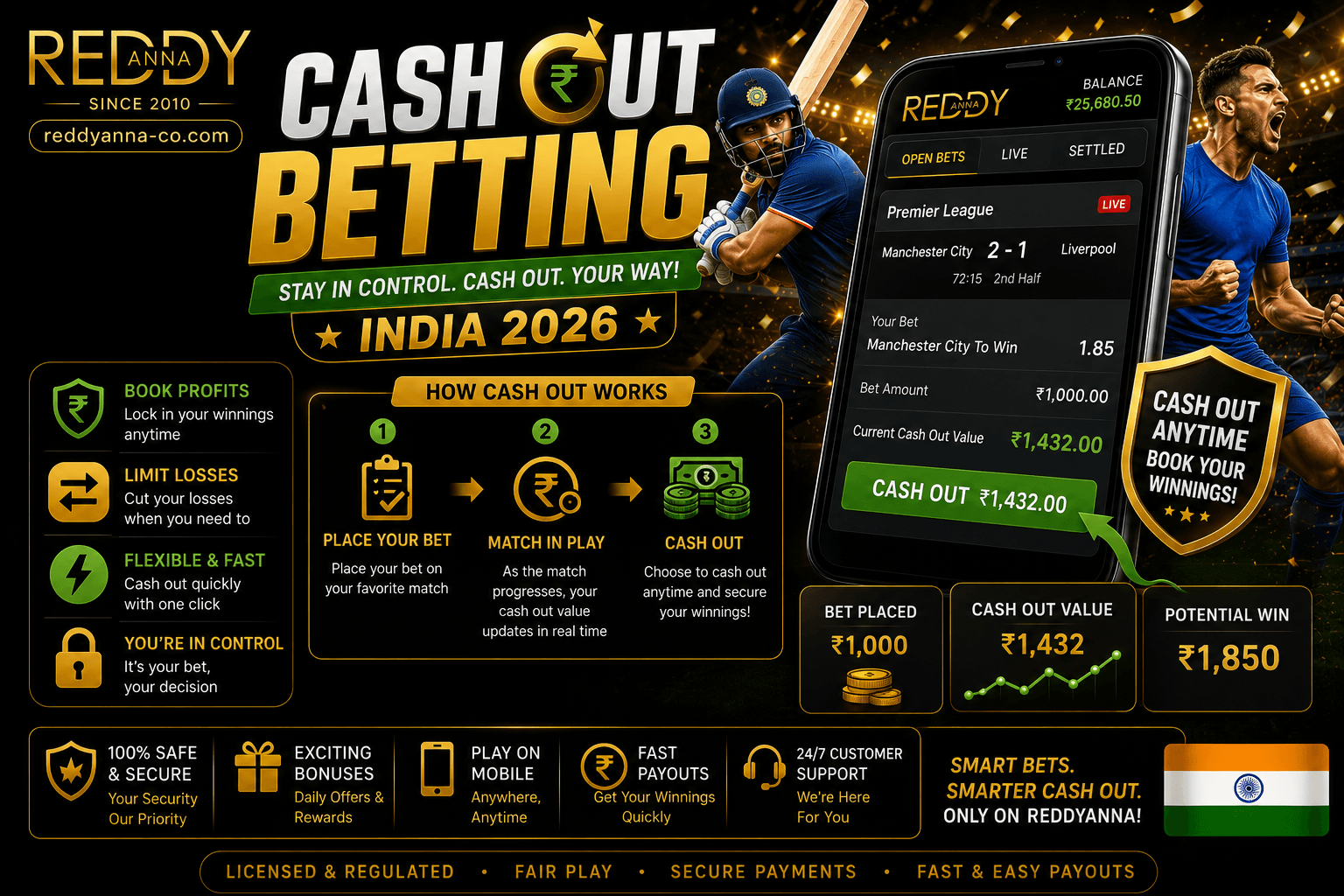
"Cash out" is a feature offered by most modern sportsbooks that allows you to settle an open bet before the event you wagered on has concluded. Rather than waiting for the final result, you accept a guaranteed payout at that moment in exchange for closing your position entirely.
The concept is simple on the surface. If you bet ₹1,000 on the Mumbai Indians to win an IPL match bettting at odds of 2.50, your potential return is ₹2,500. If MI is 120 for 2 in the 15th over, comfortably on track, the platform might offer you ₹1,800 to cash out now. You forfeit the possibility of winning the full ₹2,500, but you lock in an ₹800 profit regardless of what happens next. If MI then collapses and loses, you've protected your profit. If they go on to win easily, you've left ₹700 on the table.
That's the core trade-off, and it appears straightforward. But underneath that simple interface is something worth understanding clearly: the cash-out value is never the mathematically fair value of your bet at that moment. It's always less. The sportsbook builds a second margin into the cash-out price, just as they built a margin into the original odds when you placed the bet. You are, in effect, paying a premium for the certainty of settling early.
This is not a conspiracy. It's simply how the product works, and understanding it doesn't mean you should never use cash out. It means you should use it with clear eyes, knowing what you're paying and getting in return.
The reason platforms promote cash out so enthusiastically is also worth being honest about. When you cash out a winning bet early, the sportsbook has reduced its liability on that event. They pay you less than they'd owe if you won. From their perspective, getting you to settle early on a winning bet is profitable. Equally, if your bet is losing and you cash out to recover part of your stake, they've guaranteed themselves a return even on a bet they were about to pay out nothing on. The feature genuinely benefits bettors in specific circumstances, but it genuinely benefits sportsbooks in more circumstances than most people realize.
Cash Out Calculation Method
You'll see a number on the screen, but where does it come from? The calculation isn't published in plain English by platforms, but the mechanics are reasonably understood.
The formula most sportsbooks use is essentially this:
Cash Out Value = (Stake x Original Odds) / Current Odds
Then, the bookmaker applies their margin to that figure, reducing it slightly below the theoretically fair settlement value.
Let's make this concrete. You bet ₹2,000 on India at odds of 2.00 (a 50% implied probability). If mid-match, the current odds on India have shortened to 1.33 (reflecting India now being a heavy favorite at roughly 75% implied probability), the theoretical fair value of your bet would be:
(₹2,000 x 2.00) / 1.33 = ₹4,000 / 1.33 = approximately ₹3,008
But the platform won't offer you ₹3,008. They'll offer something in the range of ₹2,800 to ₹2,900, with the gap representing their margin on the cash-out transaction. The exact margin varies by platform and by market, but it's consistently present. The more niche the market or sport, the wider the margin tends to be.
What this means practically: the cash-out value you're shown is always a slightly unfair price from a purely mathematical standpoint. But fair and worth taking are not the same thing. The question isn't whether you're getting fair mathematical value. The question is whether the certainty of that amount is worth more to you right now than the risk of waiting.
Types of Cash Out: Full, Partial, and Auto
Not all cash-out tools are identical. Most platforms offer variants with different use cases.
Full Cash Out
This is the most common version. You settle the entire bet for the offered amount, the bet is closed, and whatever happens in the event from that point has no bearing on your account. One click, done.
Full cash out is appropriate when you've decided completely that you want out. Not half out, not testing the waters. When the conditions have changed so significantly from when you placed the bet that you no longer want any exposure to the outcome, full cash out is clean and immediate.
Partial Cash Out
Partial cash out allows you to settle a portion of your stake for an immediate payout while leaving the remainder of the bet open to run to completion. If the platform offers you ₹2,800 to cash out a ₹2,000 bet, you could, for example, cash out 60% of the bet for ₹1,680 guaranteed, while leaving 40% of your original position open for the full potential return.
This is genuinely the most sophisticated tool in the cash-out toolkit, because it allows you to guarantee some profit while retaining exposure to the upside. It's particularly useful on accumulators (multi-bets), which we'll discuss in depth later, and on long-running events like Test cricket matches, where the situation can change dramatically across multiple sessions.
The logic behind partial cash out deserves careful thought. If you believe the event still favours your original bet but want to reduce your risk exposure, partial cash out lets you do exactly that without abandoning your position entirely. You're essentially taking some chips off the table without leaving the game.
Auto Cash Out
Auto cash out allows you to set a pre-determined threshold at which your bet will automatically settle, without requiring you to be watching and manually clicking a button. You set a target cash out value, and if the live cash out offer reaches that figure, the platform settles the bet for you.
This is useful for situations where you know you'll be unable to monitor a match live. If you've bet on a cricket series result or a futures market and want to protect against a reversal during a period when you can't watch, auto cash out removes the emotional element from the equation entirely. You've decided in advance, when your thinking was clear, rather than in the heat of a tense final over.
The risk with auto cash out is setting the threshold either too low (the bet settles before reaching its potential peak value) or too high (the market never hits your threshold during a favourable window, then deteriorates). Getting the threshold right requires a realistic assessment of how much guaranteed return you actually need from a bet to be satisfied.
When Cash Out Is the Right Decision
Let's get specific. There are situations where using cash out is a genuinely rational, defensible decision, not a panic-driven one.
Situations Where You Should Let It Ride
You bet pre-match on a specific outcome based on a set of assumptions: the starting lineup, the pitch conditions, and the relative form of the teams. If something significant changes mid-event that invalidates those assumptions, cashing out is logical.
In cricket, this might look like: you backed India to win a Test match partly based on their pace attack. Jasprit Bumrah pulled up injured in the first session of day two. The condition that made your original bet attractive has changed materially. The cash-out offer reflects updated odds that factor in this development. If you believe the impact is greater than the market has yet priced in, cashing out before the market fully adjusts can even represent value.
The principle here: cash out when new information has arrived that you didn't have when you placed the bet, and that information changes your assessment of the probability more than the current cash out value reflects.
Cash Out in Accumulators: Special Considerations
This is personal and honest, and there's no shame in acknowledging it. If you've bet ₹5,000 on a cricket match and the cash out is offering you ₹9,000 at a moment when your team is ahead, that ₹4,000 profit is real money. For many bettors, the guaranteed ₹4,000 in their account right now is worth more than the possibility of ₹12,500 with the associated risk of getting nothing.
This is not the mathematically optimal play in isolation. But betting doesn't happen in isolation. It happens in the context of your actual financial life. If locking in ₹4,000 feels right for where your bankroll is, for what else is happening in your week, for your risk tolerance on this specific event, that's a legitimate reason to cash out. The mistake people make is confusing "mathematically suboptimal in theory" with "wrong for me in practice." Those aren't the same thing.
Auto Cash Out as a Discipline Tool
This is arguably the clearest and most consistently rational use case for cash out. Imagine you've placed a four-team multi-bet (accumulator) and the first three legs have won. You're now waiting on the final selection, which perhaps has odds that don't excite you, or where something has happened during the match that makes you less confident than you were pre-game.
The cash out value at this point will reflect the collective wins from your first three legs, multiplied through to the current odds on the final selection. It's often a substantial figure, because the multiplication of three winning odds has built up significant value. Walking away from that with a guaranteed profit, rather than risking the whole amount on one remaining leg, is a sensible play for most bettors most of the time.
That said, be careful not to make this automatic. If the final leg of your multi-bet is one you genuinely believe in, with no new information that undermines your original assessment, letting it ride retains full upside.
Key Principle: Information vs. Emotion in Cash Out
Test cricket creates a unique cash-out environment. A five-day match can shift dramatically based on pitch deterioration, batting collapses that weren't predictable pre-match, weather interruptions, or a spell of bowling that reshapes the entire equation. If you bet on a match result early in a Test and by the end of day three you're looking at a situation that has moved decisively in your favour, but with two days still to play and genuinely unpredictable conditions ahead, banking profit is sensible.
Long-form betting is inherently more volatile than T20 or even ODI betting, precisely because so much can happen across multiple sessions. Cash out use for Test cricket bets deserves more consideration than for a single T20 match, precisely because the window for a reversal is so much longer.
When to Leave It and Let It Ride
Now for the cases where hitting cash out is the wrong call, and they're more numerous than many bettors recognise.
When You're Reacting to Nerves, Not New Information
The most common mistake in cash-out decision-making is treating emotional discomfort as information. You backed a team that's currently ahead, but they've just looked shaky in the last five minutes. Nothing has materially changed. No injury, no red card, no weather change, no tactics shift. You're just nervous because sport is inherently uncertain.
That nervousness is not a signal to cash out. The cash-out offer at that moment is pricing in the same uncertainty you're feeling. You're not getting an escape from risk; you're paying the bookmaker's margin to avoid experiencing that risk emotionally. Over a long betting career, routinely cashing out on winning positions because you feel nervous costs a significant amount of money.
The discipline of letting it ride when nothing has fundamentally changed is one of the harder skills in betting psychology to develop. But it's genuinely valuable.
When the Cash Out Value Is Too Far Below the Implied Fair Price
Every cash-out offer includes the bookmaker's margin. Sometimes that margin is reasonable. Sometimes, particularly in more niche markets or during periods of high market volatility, the cash-out value is significantly below what the fair settlement would be. If you know how to calculate the approximate fair cash out value using the formula described earlier, you can spot when the platform is offering you an especially bad deal relative to the theoretical value.
This doesn't mean cash out when the margin is high. Sometimes the certainty is still worth the price. But it's a data point worth having. If the fair value is ₹3,000 and the offered cash out is ₹2,200, you're paying a ₹800 premium for certainty. That premium might be worth it to you. But knowing that it's ₹800 rather than ₹300 changes how you think about the decision.
When You're About to Win, and There's Little Time Remaining
One of the scenarios where people most regret cashing out: the bet has almost certainly won, and there's minimal time or probability of reversal left. In cricket, this might be the final ball of an over with your team needing two runs from eight balls with seven wickets in hand. The cash-out value will be close to, but not quite equal to, your full potential return.
Unless you are convinced something extraordinary is imminent, the correct play here is to let it ride. The margin you're handing back to the bookmaker is real money for a risk that is now very small. The expected value calculation strongly favours waiting in these situations.
When You Placed the Bet Based on Deep Analysis
There's a mindset element to this that experienced bettors understand. If you did the work before placing a bet, researched the pitch, studied the form, assessed the matchup, made a considered judgment, then watching the match unfold should rarely make you want to abandon that judgment unless something concrete has changed.
The problem with cash out is that it creates a constant invitation to second-guess your original thinking. For bettors who put real analytical work into their selections, that invitation can be counterproductive. Your pre-match analysis reflected a rational assessment of probability. Mid-match emotional reactions often don't.
Cash Out on Accumulators: A Special Case
Accumulators deserve their own discussion because they're where cash out becomes most practically relevant for many bettors and where the decisions are most nuanced.
When you're three legs into a four-leg accumulator, and three have won, the structure of your exposure has changed from when you placed the bet. You now have a large accumulated return riding on a single remaining event. Depending on your bankroll, this might be a much larger sum than you'd normally stake on a single event. That asymmetry is a perfectly good reason to at least consider partial cash-out.
The most useful approach on an accumulator with one or two legs remaining: compare what the full cash out offers are with what the remaining potential return is, and honestly assess the probability of your remaining selection winning. If the cash out represents 65% of the full potential return and you think the remaining leg has a 70% chance of winning, the maths favours letting it ride. If the cash out represents 80% of the full potential return and you think the final leg has a 60% chance of winning, cashing out is the higher expected-value play.
Partial cash out on an accumulator is often the most balanced approach: bank enough to guarantee a meaningful profit, leave enough exposure that a final-leg win delivers a satisfying additional return. It prevents the anguish of an accumulator falling apart on the last leg for a total loss while also preserving upside.
Auto Cash Out: The Discipline Tool
Auto cash out doesn't get enough credit as a psychological management tool. Here's why it matters beyond the obvious.
When you set an auto cash-out threshold at a specific profit level, you're deciding your betting preferences when you're calm, analytical, and not in the heat of watching a live event. When the threshold is then triggered automatically during the match, you've removed the emotional interference from the actual execution of that decision.
This matters because the feelings you experience watching a live event, the optimism when your team is surging, the anxiety when momentum shifts, the regret when you nearly cashed out but didn't, are genuinely detrimental to good decision-making. Auto cash out lets you pre-commit to a rational position. It's essentially a way of protecting yourself from yourself.
For bettors who notice they consistently make poor real-time cash-out decisions, whether that's cashing out too early when winning or not cashing out when losing bets are clearly going south, auto cash-out is worth experimenting with.
The Single Most Important Cash Out Principle
There are a lot of frameworks and calculations in this guide, and all of them have value. But if there's one principle to carry into every cash-out decision, it's this: base the decision on information, not emotion.
The question to ask yourself every time that cash-out button appears is simple. Has something changed since I placed this bet that changes my assessment of the probability? If yes, how significantly has it changed, and does the cash-out offer reflect that change accurately? If nothing meaningful has changed and the bet is going in your favour, the default position should be to let it run. Cashing out on a nervous feeling is paying the bookmaker a premium for certainty you didn't need. Cashing out because a key player is injured, because the conditions have shifted, because information you didn't have before has arrived; that's using the tool as it was genuinely designed to be used. The difference between those two things, between reacting to new information versus reacting to fear, is where the value in the cash-out strategy actually lives.
Final Thought: The time works for two ways
"Cash out" is a genuinely useful betting tool. It's also a feature that, if used reflexively and emotionally, hands money back to the sportsbook that you'd otherwise have won. Those two things are simultaneously true.
The bettors who use cash out most effectively are the ones who decide in advance what conditions would trigger their cash out decision, who understand what the offered value represents versus what the mathematically fair value is, and who have the discipline to let winning bets ride when nothing has actually changed.
Getting comfortable with uncertainty is part of betting online intelligently. The game isn't over until it's over, and a platform showing you a cash-out button every thirty seconds is not telling you something you need to act on. It's offering you a product that it's in your interest to buy. Sometimes buying it is the right call. Often, it isn't.