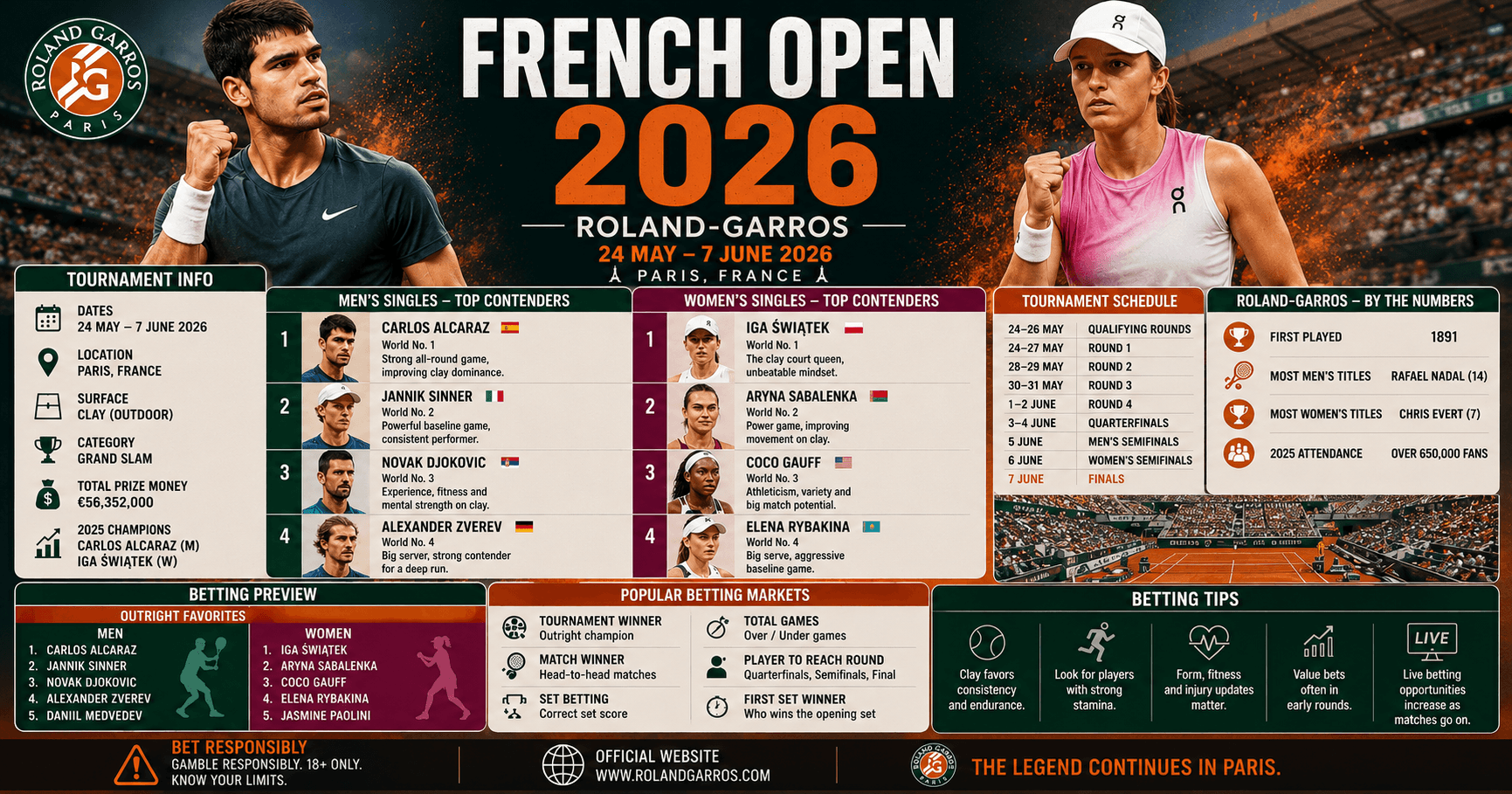
Roland Garros occupies a singular place in the tennis calendar, and any serious bettor who follows tennis betting in India already knows that the French Open 2026 is not just another Grand Slam to pick a winner and move on from. It is a tournament that unfolds over two full weeks across one of the most specific and demanding surfaces in sport, and the betting markets around it reward a different kind of preparation than any other event on the tennis schedule for 2026. Players who look unbeatable on hard courts sometimes struggle to win a set on Parisian clay, while players ranked outside the top thirty can suddenly look capable of competing with the best in the world when the conditions suit them precisely. This guide works through what makes the French Open 2026 betting markets tick, which players the evidence actually supports as genuine contenders, where the real upset potential is, and how to approach each stage of the tournament with specific, applicable research rather than broad guesswork.
How Clay Court Tennis at the French Open 2026 Shapes Every Betting Market
Understanding why the French Open 2026 produces such distinctive betting markets starts with understanding what clay actually does to the game of tennis at the elite level. This isn't a trivial consideration that affects only casual observation. It goes right to the core of how every market at Roland Garros should be assessed differently from how those same markets would be approached at other Grand Slams.
The most significant thing clay does is redistribute the power balance between the serve and the groundstroke. In most top-level tennis on hard courts, the player with the stronger serve has a structural advantage that carries through an entire match. Service games are shorter, first-serve winners are more frequent, and the returner has less time to set up and redirect pace. On Roland Garros clay, that advantage narrows substantially. The court surface absorbs pace, the ball kicks higher through the bounce, and even elite serving becomes a starting point for the rally rather than a near-automatic free point. This means matches run longer, rally exchanges extend across more shots, and the physical and tactical qualities that drive baseline construction become the primary differentiators.
For tennis match prediction, the practical consequence is that a bettor who imports their hard court assessments directly into Roland Garros markets without adjustment is working from the wrong framework. A player ranked third in the world on the basis of predominantly hard court performances over the previous six months may be a very different proposition at the French Open 2026 from one ranked twelfth who has spent years developing their clay court game and whose tennis match results on the surface reflect a specific and deep expertise.
Three Player Archetypes That Define Tennis Match Prediction at Roland Garros
One of the most useful frameworks for approaching the French Open 2026 betting is thinking about player archetypes rather than just rankings. At Roland Garros, three distinct player types perform in very different ways, and identifying which type each competitor falls into tells a bettor more about their realistic chances than an overall ATP or WTA position does.
H3: The Clay Court Specialist in the French Open 2026 Contention
The first archetype is the genuine clay court specialist. These are players whose technical and physical games are built around the demands of the slow, high-bouncing surface. They hit with heavy topspin from both wings, they move with a natural sliding footwork that covers the court efficiently on a surface where grip is different from hard courts, and they have the physical conditioning and mental patience to sustain long rallies without forcing points before the opportunity is genuinely there.
These players' tennis match results on clay, spanning multiple seasons and multiple clay court events, show a consistency that their overall ranking sometimes undersells. They may not win hard-court Masters events, but they reach finals in Rome, push through multiple rounds in Monte Carlo, and arrive at Roland Garros every year having accumulated a significant amount of competitive clay-court match time. Their betting odds in outright markets and individual match markets at Roland Garros are often shorter than at other Grand Slams relative to their ranking, and sometimes that short price is still the right bet because the surface suits them so thoroughly.
The All-Surface Performer and Their Roland Garros Ceiling
The second archetype is the high-ranked all-surface player who competes on clay without being a specialist. These are the players who dominate much of the season, winning Australian Open and US Open titles, reaching deep in Masters events on hard courts, and who enter Roland Garros highly ranked but with a clay court record that requires honest assessment rather than rank-based assumption.
For tennis match prediction at the French Open 2026, these players are often more interesting as betting market values in individual early and second-round matches than in the outright. They will beat lower-quality opponents on clay even when not at their surface-specific best. But in the later rounds, when they face genuine clay court specialists, the difference in surface suitability can produce results that their pre-tournament ranking didn't anticipate. The tennis betting tips that apply here involve checking not just their overall clay court record but specifically how they have performed in clay matches that reached four or five sets, when the physical demands of the surface become most acute.
The Emerging Clay Threat Bettors Should Watch
The third archetype is the player who has shown genuine clay court improvement over the previous twelve to eighteen months and who enters the French Open 2026 in a phase of their career where the clay court results are genuinely trending upward. These players are most visible through recent tennis highlights from the clay swing, where their technical development shows up in specific observable ways: cleaner contact on heavy topspin groundstrokes, more confident sliding footwork, better court positioning in extended rallies, and the mental composure that comes from winning close sets on clay against quality opposition.
Betting markets often lag behind the curve on these improving clay court players because the ranking system's points weighting reflects results across all surfaces, and a player who has specifically improved on clay but not dramatically across the full tour may not have moved significantly in the rankings. Their French Open 2026 odds in early-round markets can therefore carry better value than their actual clay court form justifies.
Reading Tennis Match Results for Pre-Tournament Preparation
The most specific and actionable research a bettor can do before the French Open 2026 is a systematic review of tennis match results from the clay swing that precedes it. The tournaments at Monte Carlo, Barcelona, Madrid, and Rome collectively represent four to six weeks of competitive clay court tennis at the professional level, and the results from those events are the single most predictive indicator available for Roland Garros performance.
The review should go beyond win-loss records. For each player being assessed, a bettor should look at which opponents they beat and which they lost to, how many sets those matches took, and whether the results were achieved through dominant straight-set performances or close, grinding three-set battles. A player who won three titles on clay in the swing but took three sets in most of those title matches may be carrying more match fatigue into Roland Garros than a player who won fewer matches but did so more efficiently. Both types of information are in the tennis match results, but they require looking beyond the headline win-loss column to find.
For upset prediction specifically, tennis match results from lower-tier clay events in the weeks before the major clay swing are worth checking. The Challenger circuit and lower-tier ATP 250 clay events feature players who are building form on the surface without the pressure of top-seeded opponents yet. A player who has won two of these smaller clay court events before the Madrid Masters has match confidence and surface rhythm that their ranking doesn't fully communicate, and their first-round match at Roland Garros against a higher-ranked opponent deserves more careful tennis match prediction analysis than a simple ranking comparison would suggest.
Upset Scenarios at French Open 2026 and the Tennis Highlights Evidence
Every Roland Garros produces at least one major upset in the first week that surprises the wider tennis audience, but appears much less surprising when reviewed against the evidence that was available before the match. The combination of clay's levelling effect, fresh draw matchups that bring styles together in unpredictable ways, and the potential for higher seeds to be carrying hidden fatigue from a heavy clay swing schedule creates the conditions for upsets that sharp bettors can partially anticipate.
The most reliable tool for identifying these upsets in advance is watching tennis highlights from both players' recent clay court matches. What to look for is not just the results but the character of the play. A lower-ranked player who was pushing a top-ten seed to 7-5 in the third set in Rome two weeks before Roland Garros was demonstrating a specific clay court competitiveness that the match winner market odds at Roland Garros may not reflect. Those Roland Garros match winner odds are partly based on the overall ranking gap, but the tennis highlights evidence suggests the actual gap on clay specifically is narrower.
Physical condition shown in recent tennis highlights is worth tracking separately from tactical performance. Bettors who watch clay swing matches with specific attention to how players are moving in the third set compared to the first set get useful information about their physical reserve. A player who looks significantly less mobile in the later stages of a recent clay court match, with shorter recovery steps and less willingness to slide into wide balls, is likely carrying something physical into Roland Garros that their publicly stated fitness status may not fully capture.
Specific Tennis Betting Tips for Each Phase of Roland Garros
The most practically useful tennis betting tips for the French Open 2026 are different at each phase of the tournament, which is a point that doesn't get enough attention in general betting guides.
In the first round, the most reliable value tends to be in specific markets beyond the match winner. The total games market on matches between top-ten seeds and lower-ranked opponents is worth examining with clay court calibration. Clay naturally produces more games per set than faster surfaces, and even comfortable wins for top seeds at Roland Garros tend to run higher in total games than equivalent ranking gap matches at hard court Grand Slams. Over lines that look like reasonable unders elsewhere are often appropriately priced as overs at Roland Garros.
In the second and third rounds, correct tennis score prediction becomes increasingly interesting because the quality of opponents begins to rise, and the clay court form differential between players becomes more clearly expressed. A clay specialist meeting a serve-dependent player in the third round at Roland Garros has a historical pattern that favors specific correct scores, and those patterns are visible in both players' previous Roland Garros tennis match results from earlier editions of the tournament.
From the quarterfinals onward, the most important additional input is scheduling and recovery. The tennis schedule for 2026 will show how many days of rest each quarterfinalist has had, how many sets they have played across the tournament to that point, and whether they have had any matches that ran particularly long or were particularly physical. A player going into a quarterfinal having played three five-set matches across ten days is in a measurably different physical state from one who reached the same round in three straight-set wins. This information is fully available and almost entirely underweighted in the market pricing at that stage of the tournament.
Setting Up for French Open 2026 Betting Through a Reliable Platform
All the research frameworks and market insights described in this guide require a platform that covers the French Open 2026 with genuine depth across all the relevant market types. Getting a ReddyAnna tennis ID before the tournament draw is announced is the practical first step that gives access to pre-draw outright markets at their most generously priced point in the tournament cycle. Registration involves personal details, identity verification, and payment setup, and completing it early is a straightforward process that takes very little time.
ReddyAnna covers the French Open 2026 across outright winner markets, individual match markets through all rounds, correct tennis score prediction options, first set winner and total games markets, and live in-play betting across each match day of the tournament. As a trusted betting site of India with comprehensive tennis coverage, it functions as one of the best tennis betting sites available to Indian bettors who want the full range of Roland Garros markets under one platform.
For a two-week Grand Slam, the payment side of the experience matters as much as the market side. Winnings from the first-week match bets need to be accessible for reinvestment in the second-week quarter and semifinal markets without being held in processing. ReddyAnna, as an instant withdrawal betting site, handles this practically, keeping funds available and the full tournament betting experience smooth from the first round through to the final. This combination of market depth and payment reliability is what makes the platform a well-suited choice for Indian bettors who want to engage seriously with the French Open 2026 from opening day to the trophy presentation.
Summing Up
The French Open 2026 is the most analytically rich Grand Slam on the tennis schedule for 2026, and the bettors who approach it with the most specific preparation consistently find better value than those who simply back the overall highest-ranked players. Understanding the three player archetypes on clay, reviewing tennis match results from the full clay swing rather than just the Monte Carlo and Rome headliners, watching tennis highlights for physical condition and tactical quality on the surface, and applying the phase-specific tennis betting tips that shift from first-round total games analysis through to second-week scheduling and recovery assessments, these are the habits that make Roland Garros the most rewarding tournament in the tennis betting calendar rather than just the most complicated one. Getting a ReddyAnna tennis ID before the draw, using one of the best tennis betting sites available in India for consistent market access, and approaching correct tennis score prediction with the clay-specific calibration that Roland Garros demands, that complete preparation is what turns the French Open 2026 from an intimidating two-week event into a structured, genuinely exciting opportunity for tennis betting in India at its most informed.