Ask ten people in India whether betting on horse racing is legal, and you will likely get ten different answers. Many will say that all betting online is illegal; some will say it depends on the state; a few might even say there is a special exemption, but are not sure exactly how it works. And in all that uncertainty, a really important distinction actually lies, one that not only differentiates horse racing from all other forms of sports wagering in India but also provides it with a legal status that has survived court challenges, changes in legislation, and even a major national crackdown that resulted in the closure of thousands of online platforms in 2025 and 2026.
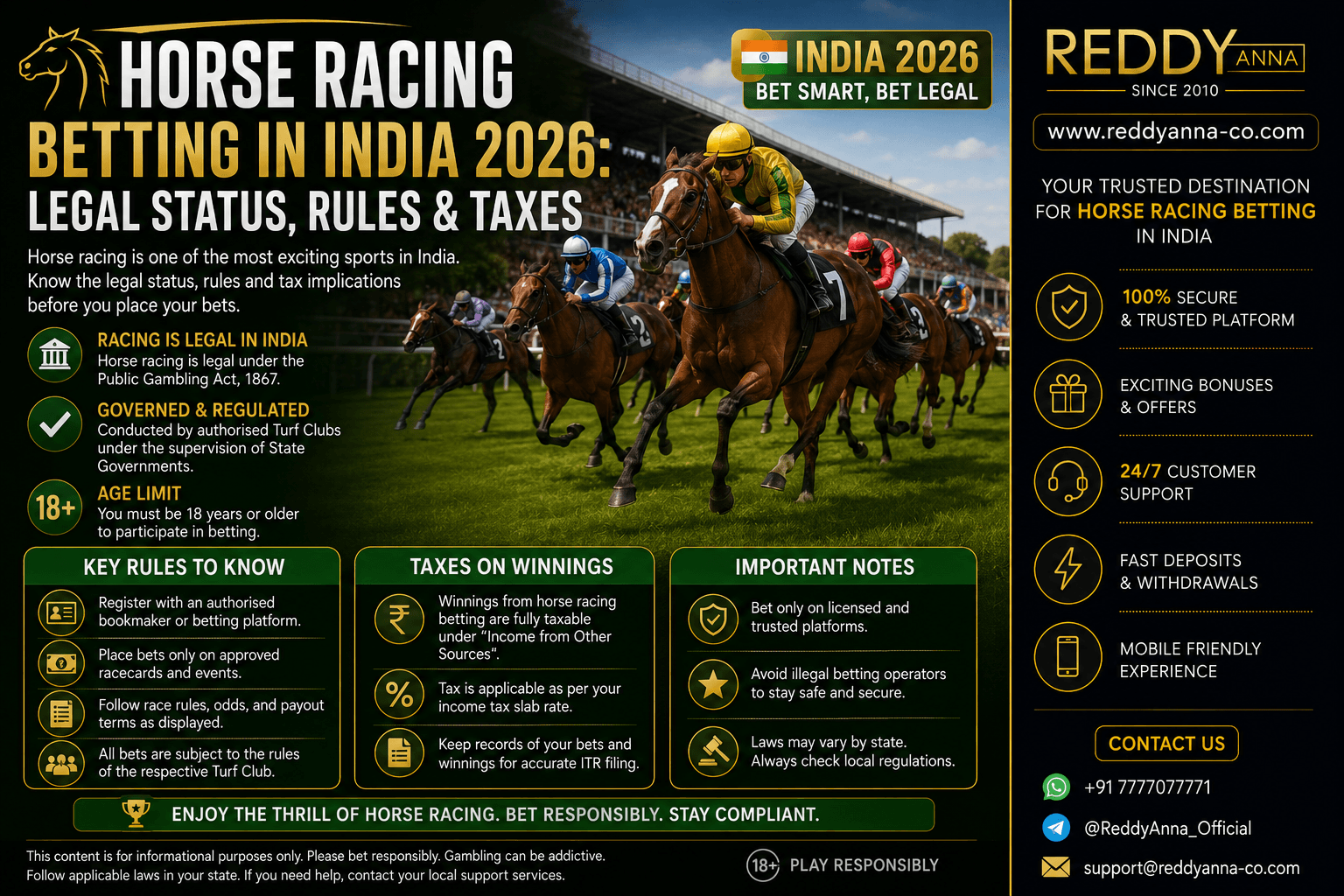
So here is the real deal. Horse racing betting in India in 2026 is not only legal but also openly regulated. Not in a grey zone, not in a loophole, not subject to creative interpretation. It is legal as per settled Supreme Court precedent, regulated by licensed turf clubs across the country, and treated as a separate category under the Income Tax Act with its own rules for winnings. This is the primary fact from which everything else in this guide stems.
It is not just the headline that tells you that horse racing betting in India is legal in 2026; it is the whole context that comes with it, the legal architecture, the industry structure, and the recent changes that lead to this topic being even more relevant today than ever before. That is what one must understand to know why it is legal, how the system operates, what the tax situation is, and finally, how to place a bet at the racecourse or through an authorised platform in 2026.
The Legal Foundation: Why Horse Racing Occupies Its Own Category
India's relationship with gambling law is one of the most complicated in the world. The Constitution places betting and gambling on the State List, meaning each state has the power to make its own rules. The central law governing gambling dates back to the Public Gambling Act of 1867, a piece of colonial-era legislation that was written for a completely different era but still forms the backbone of gambling jurisprudence across much of the country.
That old law does one thing that became the basis for horse racing's entire legal status. It prohibits games of chance but explicitly exempts games of skill. The critical question, therefore, has always been: Is horse racing a game of skill or a game of chance?
The Supreme Court answered that question definitively in 1996. In the case of Dr K. R. Lakshmanan v. State of Tamil Nadu, the Court ruled that betting on horse racing is a game of skill. The Court reasoned that a person who bets on horse races gathers information and uses that information to make an educated bet based on the analysed location of tracks, horse form, track conditions, trainer and jockey performance, and other factors. This reasoning became the basis for the many express exemptions from gambling statutes regarding horse racing that exist across Indian state legislation.
That ruling has not been reversed, challenged successfully, or qualified in the years since. It stands as settled law.
The practical result is that the Public Gambling Act's exemption for games of skill, read together with the 1996 Supreme Court judgment, places horse racing betting outside the general prohibition on gambling. Most state gaming laws across India have their own carved-out exemptions for horse racing that mirror this position. The states of Maharashtra, Telangana, and West Bengal have specifically granted permission to their respective turf clubs to offer both on-course and online betting on horse races.
What this means for someone standing at Mahalaxmi Racecourse in Mumbai, placing a bet at a tote window, or at the Bangalore Turf Club, checking the form guide before the first race of the day, is straightforward. You are participating in a legal activity. The turf club you're betting on is licensed. The bet is legitimate. The infrastructure around you, the tote computers, the race officials, and the bookmakers on the rails exist within a fully authorised regulatory framework.
The 2025 National Crackdown and Why Horse Racing Survived It
Anyone following India's betting landscape over the past year knows that 2025 was a year of dramatic change. The Promotion and Regulation of Online Gaming Act, passed in August 2025 and commonly referred to as PROGA, represented India's most sweeping attempt to regulate the online gaming space. Its effect was immediate and wide-ranging: over 7,800 gambling and betting websites were blocked from October 2025 onward. Enforcement actions froze hundreds of crores in accounts linked to illegal platforms. The grey zone that millions of Indian sports bettors had occupied for years was formally closed. But horse racing was not swept up in this crackdown, and understanding why requires understanding what PROGA actually prohibits.
The law targets "online money games," which it defines broadly as any game where users deposit money and play with the expectation of winning more money. The question of whether PROGA applies to horse racing is genuinely disputed in legal circles. Horse racing is classified as a skill game under existing Supreme Court precedent and is governed by separate state-level racecourse laws, which creates a strong argument that the central government's online gaming law does not override existing state-level racing regulations that have expressly authorised horse racing betting.
Karnataka went further by drafting its own amendments to allow licensed operators to offer online horse racing betting, directly challenging the central law's applicability to the sector. The matter is before the Supreme Court, where Karnataka and other states have argued that betting and gambling fall under the State List in the Constitution and that the central government overstepped its authority by passing PROGA.
If you want to bet on sports legally in India today, horse racing is your clearest and most legally secure option. Everything else comes with complications that horse racing simply does not have.
Understanding the Industry Structure: Who Runs Indian Racing
Before you can understand how to place a bet, you need to understand who's operating the infrastructure you'll be betting within. Indian horse racing is governed by the Turf Authorities of India, a federation comprising six principal turf clubs that collectively manage racing activities across the country. Each member club operates independently within its respective region and is responsible for organising race meetings, licensing owners, trainers, and jockeys, enforcing rules of racing, and operating the betting facilities at its venues.
The six main clubs and their racing centres are:
The Royal Western India Turf Club (RWITC) runs racing in Mumbai at the Mahalaxmi Racecourse from November to April, and in Pune from July to October. The Mumbai season is the marquee season of the Indian calendar, culminating with the Indian Derby on the first Sunday of February.
The Bangalore Turf Club operates two distinct seasons: summer from May to August, and winter from November to April. The Bangalore Derby in July is one of the major Classic races of the season.
The Royal Calcutta Turf Club manages racing in Kolkata with a winter season from November to April and a monsoon season from July to mid-October.
The Hyderabad Race Club runs racing on the Monsoon Track from July to October and the Winter Track from November to February.
The Madras Race Club conducts racing in Chennai at Guindy from October to March, and at the scenic hilltop Ooty Racecourse from April to June.
The Mysore Race Club operates its principal season from mid-August to October, with smaller summer and winter meetings.
This structure means that horse racing in India operates virtually year-round, with the calendar organised so that different cities host their major meetings at different times. There is almost always a race meeting happening somewhere in the country, which, for bettors, means that the opportunity to engage with the sport is not confined to a short seasonal window.
How Betting Works at Indian Racecourses: The Tote System Explained
Walk into any of the above racecourses on a race day, and you'll find the betting infrastructure set up around what's called the Tote, short for Totalisator. This is the foundation of how most betting at Indian racecourses works, and understanding it is essential before you put any money down.
The totalisator, or Tote, is a computerised form of pool betting. It totals all of the wagers made in a given race or combination of races, deducts taxes and fees, and divides the remaining amount among the winners as their dividend or payout. The critical thing to understand about Tote betting is that the odds you see when you walk up to the window are not fixed. They are live, floating numbers that update in real time as money flows into the pool.
If you place a bet on a particular horse at 5:30 pm showing a dividend of 8.00, and in the next twenty minutes a large amount of money comes in on the same horse, the dividend you eventually receive might be 6.50 or 5.00. Equally, if money flows away from your horse toward others, your dividend might improve. You don't know your final payout until the race has finished and the pool has been calculated.
Each club accepts bets at hundreds of automated Tote booths set up at the racecourses. You can wager by going to a manned Tote window and buying a cash voucher from a Tote Service Outlet, or by calling over the Tote's trackside roving operator, who carries a hand-held computer. Some clubs also operate off-course centres where they show races live on screen and accept Tote wagers. No matter the facility, all Tote bets made become part of the same shared pool.
The minimum bet unit on the Tote is ₹10. That's one of the features of Indian racing that makes it genuinely accessible across income levels. A knowledgeable bettor can engage meaningfully with a race for a very modest stake.
Bookmakers at Indian racecourses offer an alternative to the Tote by providing fixed odds. When you bet at fixed odds, the price you see at the time of placing the bet is what you receive if your horse wins, regardless of how the market moves afterwards. If you lock in 5/1 on a horse and it wins, you receive 5/1 even if the Tote dividend ends up at 3/1 because more money was piled in after you placed your bet.
Both systems have their merits. The Tote can produce better-than-expected returns when an unfancied horse wins and the pool is spread thinly among winners. Fixed odds give certainty and can be preferable when you've identified a price you're happy with and don't want to risk it deteriorating. Experienced punters at Indian tracks often use a combination of both depending on the race and how confident they are in their selection.
The Bet Types Available at Indian Racecourses
Indian horse racing offers a range of bet types that go well beyond simply picking a winner. Here's a clear breakdown of what you'll encounter.
Win:
The simplest bet. You pick the horse you believe will finish first. If it does, you receive the dividend. The minimum stake on the Tote is ₹10. With bookmakers, minimum stakes vary. This is the right starting point for anyone new to the sport.
Place:
Your horse needs to finish first or second (in smaller fields) or within the top three (in larger fields). The dividend is smaller than a win bet because the success condition is broader, but it provides insurance against a horse that runs well without winning.
Each Way:
A combination of a Win bet and a Place bet. Half your stake goes on the win, half on the place. If the horse wins, you collect on both. If it places without winning, you collect only the place portion. Each-way betting is particularly useful on longer-priced horses where even a placing returns a meaningful profit.
Forecast:
You select the horses that will finish first and second in the correct order. The odds of predicting this accurately are lower than a simple win bet, so the dividends are considerably higher. A Reversed Forecast allows you to select two horses and back them to fill the first two positions in either order, at double the stake.
Tricast:
Predicting the first, second, and third-placed horses in the correct order. This is one of the more demanding bets at a racecourse,e but can produce substantial dividends in large fields where unexpected horses finish in the places.
Accumulator Bets (Multi-Race):
Selecting winners across multiple races in a single bet, with the returns from each race rolled forward to the next. All selections must win for the accumulator to pay out. The compound effect on odds means potential returns grow dramatically with each leg, but the difficulty of getting multiple races correct is correspondingly great. Indian turf clubs offer various versions of multi-race bets that pool across the day's card.
Jackpot Pools:
Some turf clubs run jackpot-style pools where bettors try to predict the winner of a set number of races, often five or six on a given day. When nobody correctly predicts all winners, the pool carries over to the next meeting. Jackpot pools have historically produced some of the largest single-day payouts in Indian horse racing.
Reading the Form: The Skill Element That Justifies the Legal Status
The Supreme Court's 1996 ruling classified horse racing as a game of skill specifically because of the analysis required to bet intelligently on it. This isn't a polite legal fiction. The form study that serious horse racing bettors engage in genuinely requires expertise, and that expertise genuinely improves results over time.
Reading the form card for a race involves multiple layers of assessment. You start with the horse's recent race history, including finishing positions, margins, the class of race it competed in, and the distance it ran. A horse that finished second in a Group 1 race last month is a fundamentally different proposition from one that won a maiden race at the bottom of the scale.
Then there is the question of the weather conditions. Indian racecourses experience significantly different ground conditions depending on the season and recent weather. Some horses thrive on firm, fast ground and find heavy going completely unsuitable. Others are specifically bred for softer surfaces and produce their best performances when the track rides slower and is more demanding. Understanding a horse's preference for going conditions, and checking what the going is officially declared to be on race day, is a basic form of study task that makes a real difference to betting outcomes.
Weight is another critical variable in handicap races. Indian racing uses a weight-for-age scale in Classic races and a handicapping system in other races. A horse carrying less weight than it has in comparable previous runs has a physical advantage that is worth quantifying before placing a bet.
The track draw matters in certain race types and at certain racecourses. At Mahalaxmi, where the oval track creates definite rail advantages depending on the going, the draw from which a horse starts can influence race tactics significantly. Form students who track draw statistics at individual racecourses over multiple seasons can identify genuine edges.
How Taxes Work on Horse Racing Winnings in India
This section matters as much as the legal status discussion, because too many people who engage with horse racing betting don't understand their obligations when they win.
Income from horse races falls under the heading "Income from Other Sources" and is taxed at a flat rate of 30% under Section 115BB of the Income Tax Act. As per Section 194BB of the Income Tax Act, earnings from horse race winnings for a single transaction above ₹10,000 will be applicable for Tax Deduction at Source (TDS) at a flat rate of 30%.
Here is how it works practically. If you win ₹90,000 from a bet at a licensed turf club, the club will deduct ₹27,000 as TDS before paying you. You receive ₹63,000 in hand. But your legal obligation doesn't end there. You are still required to file an Income Tax Return for the year in which you received the winning amount, even if TDS has already been deducted,d and you owe no additional tax.
There are no deductions available against horse racing winnings. You cannot claim Section 80C investments, 80D medical insurance premiums, or any other standard deductions against this income. The 30% rate is calculated on the gross winning amount, not on profit above your original stake. If you bet ₹500 and win ₹12,000, the taxable amount is the full ₹12,000, not the ₹11,500 profit. On top of the 30% tax rate, a Health and Education Cess of 4% applies, bringing the effective tax rate to 31.2%.
The ITR form you need to file depends on your other income sources. If your horse racing winnings are your only income or they combine with simple income below ₹50 lakh, ITR-2 is the appropriate form. ITR-1 cannot be used if you have winnings from horse races. Always declare the full gross amount, not the net received after TDS. The TDS deducted is shown in your Form 26AS and Annual Information Statement (AIS), and must be entered separately in your return as a tax credit.
The 28% GST Problem That Threatens the Industry
One aspect of Indian horse racing's current situation that doesn't get enough mainstream attention is the devastating impact of the 28% GST levied on the full face value of bets.
From October 2023, the GST Council began applying a 28% tax not on the net margin of betting operators, but on the total value of bets placed. This is a dramatically different tax base. If ₹1,000 is bet at a Tote window, ₹280 goes to GST before any other deduction. The effective amount available for the prize pool and operating costs is just ₹720.
The results for the industry have been visible and severe. Hyderabad's tote revenues fell from ₹1,271 crore in 2016-17 to just ₹141 crore in 2024-25. Mumbai's tote has collapsed to a fraction of its historical levels. Turf clubs across the country have been lobbying the GST Council for relief, arguing correctly that a 28% levy on turnover, not on profit, is destroying an industry that legally cannot pass the cost on in any meaningful way.
This context matters for bettors because it explains why the dividends at Indian racecourses have been lower than historical averages, and why the industry is not as financially robust as its legal status might suggest. A legal industry under extreme tax pressure is one that is contracting, not growing. The hope from within the industry is that the GST Council will recognise that 28% on turnover is not comparable to 28% on other gaming activities, and that some form of relief or restructuring will emerge. As of mid-2026, that relief has not arrived.
A Practical Step-by-Step: How to Bet at an Indian Racecourse
If you've never been to an Indian racecourse and want to know what to expect, here's what a typical race day betting experience looks like. Arrive at the racecourse and pick up the race card (or programme) for the day. This document lists every race on the card, the horses running in each race, the jockeys, trainers, weights, and recent form. Study this carefully before betting on anything.
Go to the form guide section of the race card for the race you're interested in. Check the horse's last three to five runs: where it finished, what the going was, what distance it ran, and what the margin was. Notice the class of race each result came from. Look at who is riding and who is training.
Once you've identified a selection you're interested in, check the live Tote odds being displayed on the screens around the venue. These update frequently. Note the odds on your selection and compare them to what you might expect given the horse's form.
Walk to a Tote booth or a manned Tote window. Tell the operator the race number, the horse number, the type of bet (Win, Place, Each Way, etc.), and your stake. The minimum stake is ₹10. The Tote will print you a ticket. Keep this ticket safe. It is your claim to any payout.
Watch the race. If your horse wins or places, take your ticket to the collection window after the official result is declared. Present your ticket and receive your payout.
For winnings above ₹10,000 from a single transaction, the turf club will ask for your PAN details and deduct TDS before paying you. Keep the TDS certificate you receive, as you'll need it when filing your income tax return.
The Indian Racing Season: When to Engage
Part of betting intelligently on Indian racing is understanding the calendar. The season is structured around weather patterns to give horses the best possible racing surfaces.
Mumbai hosts India's flagship season from November to May, culminating in the Indian Derby in February and the other classic races through the winter. If you're new to Indian racing and want to experience the sport at its peak, the Mumbai winter season is where you should start.
Bangalore carries the summer season from May to August, followed by a winter season from November to April. The Bangalore Derby in July and the summer trial races are significant form markers for horses who will eventually target the Mumbai Classics.
Pune runs through the monsoon months from July to October, filling the calendar when other tracks are in their off-season. Some of the Pune form is particularly valuable for assessing which horses have the stamina for the 2,400-meter Derby distance, as monsoon ground conditions test staying power.
Kolkata, Hyderabad, Chennai, and Ooty fill in further across the calendar, meaning that if you live in any of these cities, there's a racecourse within reach and a season to engage with.
The Bigger Picture: Why This Matters in 2026
There's something worth saying plainly at the end of this guide. Horse racing betting in India in 2026 sits in a position that few recreational activities can claim: it is legal, regulated, taxed transparently, and protected by thirty years of settled Supreme Court precedent.
While thousands of offshore betting platforms were blocked and their users exposed to legal risk, horse racing bettors who engaged through licensed turf clubs went about their season without any of that disruption. The Indian Derby at Mahalaxmi drew its crowd on the first Sunday of February. The tote pools were calculated and paid out. The TDS was deducted correctly. The ITRs were filed.
That is how a legal, regulated betting activity operates. And it's a model that's genuinely accessible to anyone willing to put in the time to understand it. The form study is real work. Understanding the tote system takes some practice. The tax obligations require care. But the reward for doing all of this correctly is participation in something that has been part of Indian sporting life for over two hundred years, at major venues in cities across the country, within a framework that the highest court in the land has explicitly and repeatedly affirmed is legal.
That is a different position from almost everything else in India's betting landscape right now, and it's one that serious bettors who want to engage with the sport should understand clearly.