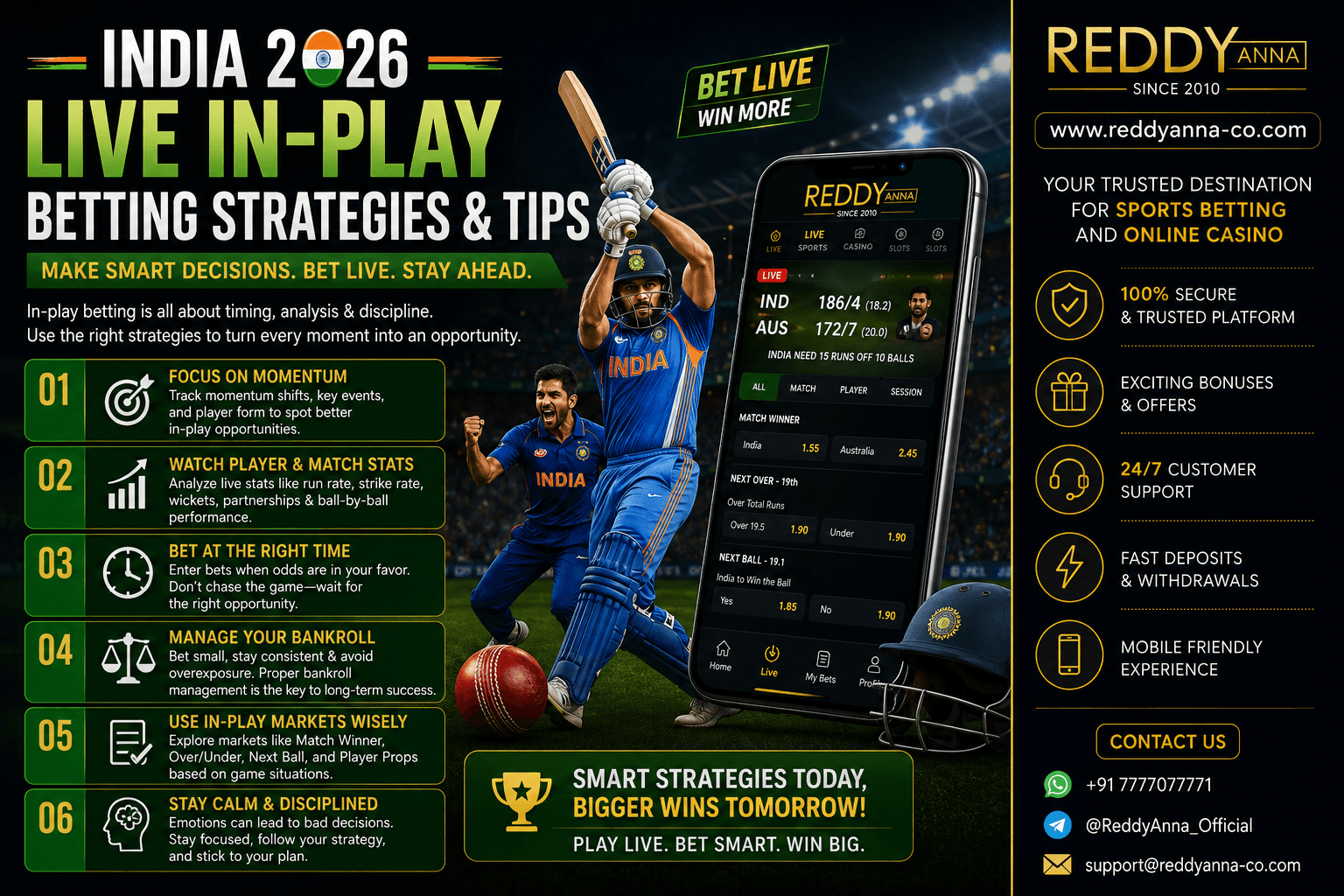
There is a particular kind of tension that comes with watching a match you have money on. Every passage of play matters. Every decision by a manager, every moment of individual brilliance, or defensive mistake carries real weight. Now imagine that during all of that, you are also making decisions. Reading the game, identifying moments where the odds do not reflect what you are seeing, and placing bets in real time while the action unfolds are key. That is in-play betting online, and it is genuinely one of the most engaging forms of sports wagering available today.
In-play betting, sometimes called live betting, has completely changed how a significant portion of bettors interact with sport. What used to be a pre-match exercise, picking your selections before a ball was kicked or a delivery was bowled, has evolved into something far more dynamic. The market reacts in real time. Prices shift with every significant moment. And the bettor who can read a game well enough to identify when those shifting prices represent real value has an opportunity that simply did not exist in the pre-match-only era.
This guide is going to walk you through how in-play betting actually works under the surface, what makes it different from pre-match wagering, which markets tend to be most useful for live betting, and the thinking that separates people who use it well from those who treat it as a way to chase losses or make impulsive decisions mid-game.
How In‑Play Betting Works Behind the Scenes
When you place a pre-match bet, the bookmaker has had hours, days, or sometimes weeks to build and refine their pricing model. They have access to team news, historical data, statistical models, public betting sentiment, and the opinions of professional traders. By the time a market opens to the public, it reflects a substantial amount of information processing.
In-play betting operates in a completely different environment. The match is live. Things are happening right now. And the bookmaker's job shifts from long-range pricing to real-time risk management. This is a meaningfully different challenge, and the way platforms handle it has a direct effect on your experience as a bettor.
Automated Pricing Models and Real‑Time Odds
Modern sportsbooks use sophisticated algorithms to generate in-play prices. These models take a continuous stream of match data, current score, time elapsed, possession statistics, shots, cards, momentum indicators, and adjust odds accordingly. When a goal goes in, the model recalculates every related market almost instantly. The team that just scored becomes shorter, the conceding team drifts out, and markets like total goals and next goalscorer get repriced on the fly.
The speed of this process is genuinely impressive, but it also creates windows. No algorithm captures every nuance of what is happening on the pitch in real time. A goalkeeper making a string of incredible saves, a midfielder pulling the strings in a way that pure statistics do not fully capture, a substitution that visibly changes a team's shape and energy before the model has processed the implications. These are the moments where a bettor watching the game closely and thinking clearly can sometimes identify a price that does not fully reflect the current reality.
Market Suspensions and Why They Happen
One of the things you will notice immediately when betting in-play is that markets get suspended regularly. Before a penalty is taken, while a goal is being checked by VAR, during injury stoppages, and often just after a significant event like a goal or red card, the bookmaker will temporarily pull the market while they reprice. This is a normal part of the in-play experience and exists to protect the platform from being exploited during moments of extreme uncertainty.
Some bettors find suspensions frustrating, particularly when a price disappears at exactly the moment they wanted to act. The practical response is to act slightly ahead of the obvious trigger points rather than waiting until the moment has fully developed. If you can see a penalty situation developing, the price you want will likely be gone the moment the referee points to the spot.
Streaming, Data Feeds, and Information Quality
The quality of your in-play betting experience is directly linked to the quality of the information you are working with. If you have access to a live stream of the match, you are working with the most complete and real-time picture possible. If you are relying on a text commentary feed or a statistical data overlay, there is an inherent delay built in, and you need to account for that in your timing.
Many platforms integrate live streaming directly into their in-play sports book betting interface, which is a significant advantage. Watching the game and seeing the prices simultaneously allows you to react to what you are actually seeing rather than to a delayed data representation of it. Wherever possible, use a live stream when betting in-play.
Key Differences Between In‑Play and Pre‑Match Betting
Beyond the obvious timing difference, in-play and pre-match betting require genuinely different skills and a different kind of preparation. Understanding these differences helps you approach each format appropriately rather than applying the same habits across both.
The Information Landscape Shifts
Before a match, both you and the bookmaker are working from the same public information pool, plus whatever proprietary data they have access to. Once the match starts, you have something the pre-match model cannot fully anticipate: you can see what is actually happening. A team that the pre-match odds considered a narrow favourite might look completely dominant after fifteen minutes of live play. Or the opposite. The actual performance often deviates from the pre-match expectation, and in-play markets are where those deviations can be exploited.
The flip side of this is that the bookmaker's live traders and algorithms are watching the same game. The advantage you have as a human watcher is qualitative and contextual. The bookmaker's advantage is speed and volume. They can process hundreds of data points per second. You can process the feel of the game. Both of those edges exist simultaneously, which is what makes in-play betting a genuine contest rather than a completely one-sided proposition.
Decision‑Making Under Time Pressure
Pre-match betting allows you to research at your own pace. You can check multiple sources, sleep on a decision, and place your bet at any point before kick-off. In-play betting gives you seconds or at most a few minutes before a price changes. This time pressure introduces a psychological element that does not exist in the same way pre-match.
Bettors who struggle with impulsive decision-making tend to make their worst choices during live matches. A team goes behind, and the bettor backs them to come back because they are the better team, and the price has become attractive. Maybe that is a good bet on the numbers, but if the decision is being driven by wanting the match to go a certain way rather than an honest assessment of the revised probabilities, the in-play environment is making the problem worse rather than better.
The discipline required for in-play betting is arguably greater than for pre-match, precisely because the emotional stakes are higher and the decision windows are smaller. We will come back to this in the strategy section.
The Role of Cash Out in Live Betting
In-play betting is where the cash-out feature becomes most relevant and most useful. Pre-match, you might occasionally use cash out if a match goes badly, but in-play is where you can actively use cash out as part of your approach, locking in returns as a bet develops in your favour or limiting losses when things start to go against you.
Understanding cash-out values during a live match requires a feel for how the bookmaker is pricing the remaining risk. A cash-out offer that seems low is sometimes worth taking if you read the remaining match dynamics as genuinely uncertain. A cash-out offer that seems generous might reflect a market that is pricing the situation more favourably than the live reality warrants. Developing this judgment takes time, but it is a genuine skill that adds another dimension to in-play betting.
Best In‑Play Markets for Bettors
·
Not all in-play markets are created equal. Some are well-suited to live betting because they offer enough price movement and enough genuine edge opportunities. Others are better avoided because they are too fast, too difficult to predict in real time, or priced too tightly for any realistic edge to survive the margin. Here is a breakdown of the markets that tend to reward informed live betting.
Next Goal Scorer
This market often produces significant value during in-play betting, particularly after a team has made a substitution or a tactical change that shifts who is most likely to be involved in the next attacking move. If a striker who has been isolated suddenly has a more creative midfielder behind them after a substitution, and the market has not fully repriced that shift, there can be genuine value in the next goalscorer market.
The key with the next goalscorer is watching movement patterns and set-piece tendencies rather than just recent shot counts. A centre-back who keeps getting forward for corners, a forward who is repeatedly found in dangerous positions even if they have not scored yet, these are the observations that a data model might underweight, but a watching human can pick up clearly.
Over or Under Total Goals
The total goals market is one of the most popular in-play markets for good reason. It reacts predictably to the score and time elapsed, and it offers opportunities both when a game is more open than pre-match expected and when it is tighter. A 0-0 match at half-time, where both teams are creating genuine chances but finishing poorly, might offer value in the over market at a price that reflects the score rather than the underlying match dynamics. Conversely, a 1-0 match where the trailing team is not seriously testing the opposition might offer value in the under market if the live price has not fully caught up to the defensive reality of the situation.
Experience with this market develops a feel for the tipping point between a game that is goalless because it is tight and one that is goalless because it is open, and goalmouth opportunities keep being missed. That distinction matters enormously for pricing the total goals market correctly, and it is a judgment call that watching the game gives you a genuine advantage in making.
Match Result After Current Score (Handicap In-Play)
Many platforms offer a live Asian handicap or result market that adjusts to the current score. So rather than simply betting on the outcome, you can bet on a team to win or cover a handicap from the current live position. This is often where the most interesting value appears, particularly when a strong team goes behind, and the price for them to win from that position has moved significantly.
The logic here is straightforward: if a team was priced at 1.60 to win pre-match and they go a goal behind in the 25th minute, their win probability drops substantially. But if the goal was against the run of play, if the team is still clearly the better side, and the goal came from a counter-attack or set-piece, the live price might be overstating how much the goal has changed the match dynamics. Backing that team at 3.00 or 3.50 in a spot where your honest assessment says they still have a 35% to 40% chance of winning is a bet with real positive expected value.
Next Team to Score
Simpler than the next goalscorer but often underused, the next team to score in the market can offer value around substitutions, tactical changes, and momentum shifts that are visible to a watching bettor before they are fully reflected in the price. A team that has just changed to a more attacking setup, brought on a forward for a midfielder, and is visibly pushing for an equaliser often sees its next-goal odds move more slowly than the visual evidence would justify.
This market is also useful in matches where one team is clearly dominant in a specific phase of the game. If a team has played the last fifteen minutes entirely in the opposition's half, pressing relentlessly, the next-team-to-score market on that team carries a qualitative edge that pure statistics might not fully capture.
Live Cricket Markets
For bettors who follow cricket closely, in-play markets offer some of the richest opportunities of any sport. The match is long, conditions change, and the probabilities shift substantially based on factors like pitch behaviour, batting partnerships, and bowling changes that a regular cricket watcher can assess in real time.
Over-by-over runs markets, wicket in the next over, and session totals are all popular in-play cricket markets. The value in these markets often comes from understanding how a particular pitch is playing rather than from pre-match statistical models, which tend to smooth out conditions over historical averages. If you watch the first few overs of a Test innings and can see that the surface is offering significant seam movement that the pre-match model did not fully price in, the live wickets markets for that session can reflect a genuine information advantage.
IPL matches offer a compressed version of this dynamic, with the shorter format producing rapid probability swings across a 20-over innings. The over totals and match winner markets move frequently and sometimes dramatically, and for bettors who follow the IPL closely and understand team-specific strategies in different match situations, there are regular opportunities where the live price does not match the live reality.
Basketball Live Markets
Basketball has one of the best in-play betting profiles of any sport because of the frequency of scoring, the clear structure of quarters, and the well-documented tendency of leads to be overvalued in the first half and undervalued in the fourth quarter. A team that is down by twelve at half-time in an NBA match is often priced as if the game is nearly over when the statistical reality is that twelve-point deficits are overturned at a meaningful rate, particularly with timeouts and tactical adjustments available.
Quarter and half markets allow you to bet on individual sections of the game rather than the full result, which is often where the clearest value sits in live basketball. A team that has had a poor shooting quarter due to variance rather than defensive domination, where the shot selection and positions have been good but the ball simply has not been going in, is a candidate for a strong next-quarter performance that the live price might underweight.
Tennis Live Betting
Tennis offers in-play betting at a granular level. You can bet on individual games, individual sets, and overall match results, all while watching the momentum and serving patterns of the match unfold. The serve is everything in tennis, and a player who is holding serve comfortably but facing a breakpoint at a key moment can be mispriced in the live market if the model weights recent service games more heavily than the current tactical situation.
Break of serve markets and next game winner are often the sharpest in-play tennis opportunities because they require very specific contextual knowledge. A player who historically breaks down physically in the third set, a server who visibly struggles in windy conditions, a player whose second serve becomes exploitable late in a tight match. These patterns are visible to anyone who follows the players closely, and they are the kind of contextual information that live models are slowest to fully incorporate.
Strategy Principles for Successful In‑Play Betting
·
Having the right approach to in-play betting matters as much as knowing which markets to target. Here are the principles that make the biggest practical difference.
Watch Before You Bet
Resist the urge to place in-play bets within the first few minutes of a match unless you have a specific pre-planned reason to do so. The early stages of a game often see prices that are still adjusting from the pre-match position, and the pattern of play has not yet established itself clearly enough to justify strong live positions. Give the match ten to fifteen minutes to reveal its shape, and then assess what you are seeing against what the current prices are saying.
Have a View Before the Match Starts
The best in-play bettors often arrive at a match with a thesis. They have a view on how the game is likely to develop, which team they expect to be in control, and what game script they think is most probable. That pre-formed view gives them a reference point against which to assess the live prices. If their thesis is playing out and the price for that outcome has moved against them because of a single atypical moment, they have the context to decide whether that represents value or a genuine reassessment.
Bettors who arrive at in-play markets cold, with no pre-match analysis, are largely reacting to what they see with no reference framework. That is a much harder way to identify value consistently.
Set a Live Betting Budget Separately
If you manage a betting bankroll, it is worth allocating a specific portion of it to in-play activity and treating it as a separate budget. In-play betting can be faster and more emotionally charged than pre-match betting, and having a clear ceiling on what you are prepared to commit during a live event prevents the situation where you keep adding positions throughout a match without tracking what you have cumulatively at stake.
Many experienced in-play bettors will identify one or two specific spots per match where they want to act rather than treating the entire 90 minutes as an open betting window. This selectivity keeps the quality of their decisions higher and prevents the kind of continuous low-quality betting that an engaging match can tempt you into.
Do Not Chase Pre-Match Losses In-Play
This is one of the most common mistakes in live betting and one of the most destructive. A pre-match bet has gone against you early in the match. Rather than accepting the loss and watching the game neutrally, you start placing in-play bets trying to recover. The emotional connection to the pre-match position clouds your judgment on the live bets. You are no longer assessing the live market clearly; you are trying to make yourself whole, which is a completely different objective and one that produces consistently bad decisions.
The pre-match bet and the in-play betting opportunity are separate decisions. They need to be evaluated independently. If you cannot watch a live match where your pre-match bet has gone badly without wanting to pile into in-play markets, the healthiest response is not to have in-play markets open during that game.
React to Events, Not to Score Lines Alone
The score is one data point. It is not the full picture. A 1-0 lead for a team that is being outplayed is a completely different situation from a 1-0 lead for a team that is dominating. The live price on the trailing team might be similar in both scenarios because the algorithm weights the score heavily. But the underlying market reality is very different, and that is where a watching bettor has genuine information that the price does not fully reflect.
Train yourself to think about probability rather than results. What is the realistic chance of each outcome given everything you can see right now, not just the score? If your honest assessment of that probability is meaningfully different from what the live price implies, you have found a bet worth considering.
Common In‑Play Betting Mistakes to Avoid
Even experienced bettors fall into patterns that cost them money, specifically in the in-play environment. Being aware of these helps you recognise them before they do damage.
Over-Betting on One Match
The excitement of a live game, particularly one that is going back and forth, can lead to placing far more bets than the situation warrants. You place a bet on the next goal, then another on the match result, then cash out, then place another. By the end of the game, you might have placed seven or eight bets on one match. Even if each decision was reasonable, the cumulative exposure and the drag of the bookmaker's margin across all those bets is working heavily against you. Be selective. One or two well-chosen in-play positions per match is better than a constant stream of activity.
Ignoring the Time Dimension
Time remaining in a match completely changes the probability landscape. A team that is a goal behind with 40 minutes left has a meaningful chance of equalising. The same team, a goal behind with eight minutes left, has a much smaller chance. This sounds obvious, but bettors regularly misjudge how much difference ten or fifteen minutes makes to the realistic probability of an outcome changing. Always factor in how much time is left and how many goals would need to be scored for the current market to settle in a given way.
Treating In-Play as Entertainment Spending Without Realising It
There is nothing wrong with enjoying in-play betting as part of watching a match. But there is a meaningful difference between treating it as informed wagering with a positive expected value framework and treating it as a form of interactive entertainment where you are essentially paying for heightened engagement. The second approach is fine if you are aware that this is what you are doing and you have budgeted for it. The problem comes when you believe you are betting with an edge while actually just betting for the thrill. Be honest with yourself about which mode you are in.
Technology Tools That Give Bettors an Edge
The quality of tools available for in-play betting has improved dramatically. Using them intelligently gives you a better information picture to work from.
Live statistics overlays within sportsbook platforms show real-time possession, shots on target, dangerous attacks, and other match metrics. These are useful reference points but should complement rather than replace what you can see on a live stream. Statistics lag slightly behind events and do not always capture momentum accurately.
Dedicated match statistics sites that pull data feeds from multiple sources can give you slightly richer information than what appears in the standard sportsbook interface. Shots from inside the box, expected goals in real time, heat maps of where attacks are coming from. For bettors focused on in-play totals and next goal markets, this level of detail is genuinely useful.
Price comparison tools that track odds movements across platforms can also be valuable. If a price has moved significantly across multiple books in the same direction, something has happened or is happening that traders are reacting to. Understanding the direction and speed of price movement tells you something about how the market as a whole is assessing a live situation, even before you have processed all the visual evidence yourself.
Responsible Gambling in Live Betting
It would be incomplete to write about in-play betting without addressing the responsible gambling dimension honestly. The live format is the one that carries the highest risk of problematic behavior for a subset of bettors, precisely because of the features that make it exciting.
The speed of decisions, the emotional connection to a live match, the ability to place dozens of bets in a single afternoon, and the constant availability of new markets to enter mean that in-play betting can escalate quickly for someone who is not approaching it with discipline. The same features that make it engaging for a careful bettor make it genuinely risky for someone who struggles to set and maintain limits.
Most reputable platforms offer deposit limits, bet limits, and time-based cooling-off features. Using these proactively rather than reactively is a sign of clear thinking, not weakness. Setting a session limit before you open a live match and committing to it before emotions are involved is far more effective than trying to make that decision in the middle of an exciting game.
If you notice that in-play betting is producing a pattern of chasing losses, escalating stakes as a match develops, or leaving you feeling worse rather than better after a session, regardless of the financial result, those are signals worth taking seriously. The format rewards discipline and punishes its absence more visibly than almost any other form of betting.
Final Thoughts: Building a Disciplined In‑Play Betting Approach
In-play betting is, at its best, an intellectually engaging form of sports wagering that rewards knowledge, contextual awareness, and real-time judgment in a way that pre-match betting simply cannot. The opportunity to watch a match develop, identify moments where the live price does not match the live reality, and act on that assessment is a genuinely skill-based activity when approached correctly.
The best in-play bettors are fundamentally good sports watchers who have added a structured betting framework on top of their knowledge. They arrive with a thesis, watch patiently, act selectively, and manage their exposure carefully. They use cash out as a deliberate tool rather than an emotional response. They keep records of their live bets and review them honestly. And they know the difference between a bet they placed because the numbers were right and one they placed because the match had them emotionally invested.
The live sports betting bankroll environment is rich, fast-moving, and full of opportunity for those who approach it with the right preparation. Give it the respect it deserves, and it will reward you for it.