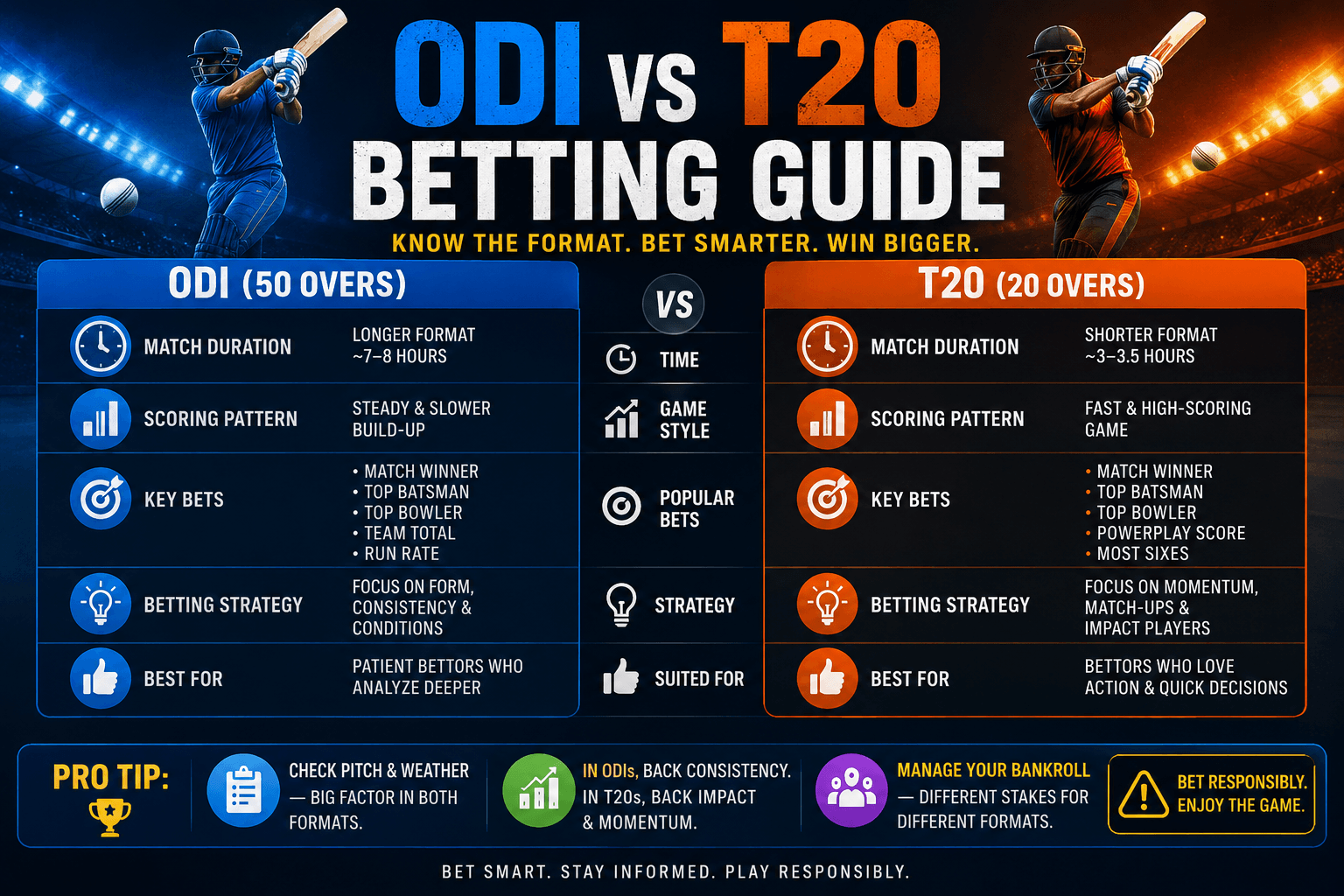
It's a question that comes up more often than most people expect when Indian cricket bettors start moving beyond just placing match winner bets and actually think about where their money is most likely to work for them. Both ODIs and T20s are played on the same grounds, by the same players, under the same basic rules, and yet the betting experience across these two formats is genuinely different in ways that matter. The odds behave differently, the markets move differently, and the research that goes into a good bet looks different depending on which format is being played. This guide takes a careful, honest look at ODI betting and T20 betting side by side, not to declare one a universal winner, but to explain where each format creates the most value for a bettor who is willing to do the preparation properly.
Why the Format Matters More Than Most Bettors Realise for Cricket Match Prediction
The format of a cricket match shapes everything about it, how teams approach the game tactically, how much risk they take with their batting order, how bowlers manage their spells, and crucially for bettors, how predictable or unpredictable the outcome is likely to be. A good cricket match prediction in a T20 needs to account for factors that barely matter in an ODI, and vice versa. Understanding these differences is the first step toward identifying where genuine value sits in each format's betting markets.
In a T20, 120 balls determine the result. A single over that produces three sixes and a wide can shift the match's entire trajectory. A batting powerplay that loses two key wickets in its first three overs can make a competitive total feel out of reach before the match is a third of the way through. The variance in T20 outcomes is inherently high, the format was designed to be explosive and unpredictable, and that character runs through every game.
An ODI gives each team 300 balls across fifty overs. That's more than double the deliveries, which means there's time for a team that starts poorly to recover, time for a partnership to rebuild, and time for bowlers who struggle early to find their rhythm later. Results in ODIs are more consistently aligned with the quality gap between the two sides. When a strong team faces a significantly weaker opponent in an ODI, the stronger team wins far more consistently than they might in a T20 played between the same sides.
T20 Betting: High Action, Faster Markets, Greater Variance
The core characteristic of T20 betting from a market perspective is speed. Markets open, odds move, and bets settle faster than in any other cricket format. Pre-match prices on a T20 can shift several percentage points in the hour before the toss if significant team news breaks, and a key player's name missing from the playing XI can move the odds noticeably on most platforms. During the match, in-play markets are among the most active in cricket betting, with over-by-over and even ball-by-ball markets available on reliable platforms.
For cricket match prediction in T20 cricket, the variables that matter most include the powerplay batting order, the death-over bowling attack, and whether the team has the kind of finishers who can accelerate in the final four overs. These are specific, current-form questions rather than broad quality assessments. A team's last five T20 results, and specifically how they've performed in powerplay and death-over phases, tend to be more predictive than their overall ranking or win-loss record across all formats.
The odds in T20 betting tend to be tighter than in ODIs for matches between closely matched sides, because both teams genuinely have a realistic chance in a format this short. But the betting odds on bigger mismatches, a strong international side against a weaker one, don't always compress as much as they logically should, because casual bettors tend to back the underdog more readily in T20s than in longer formats, which nudges the underdog's price shorter and the favourite's price slightly longer than pure probability would justify. A bettor who correctly identifies a genuine quality gap in a T20 fixture can sometimes find the favourite priced at better value than expected precisely because of this dynamic.
The downside of T20 betting from a value standpoint is the variance itself. A bettor can do excellent research, identify a strong favourite correctly, and still lose the bet because a single over went badly or a fielder dropped a crucial catch at the wrong moment. Over a large enough sample of bets, sound cricket match prediction will produce the right outcomes, but individual T20 results carry enough randomness that short-term results are less reflective of decision quality than in longer formats.
ODI Betting: More Predictable, Deeper Markets, Different Value Profile
ODI betting operates on a different rhythm. The fifty-over format gives both teams more room to express their full capability, which means the stronger team wins more consistently than in T20s. This consistency is actually what creates a specific type of value in ODI markets, not in the match winner bet itself, but in markets that reward a deeper understanding of how a match is likely to develop across its phases.
ODI innings have a well-documented structure that experienced bettors learn to recognise and use. The powerplay produces wickets and boundaries in proportion that is fairly predictable across most professional matchups. The middle overs, roughly overs 11 to 40, tend to be where batting sides consolidate, and bowling sides try to build pressure. The death overs return to a higher-tempo exchange between powerful hitters and specialist death bowlers. Each of these phases has its own betting markets, session totals, first wicket timing, powerplay run totals, and each phase is more researchable in an ODI than in a T20 because there's enough of the match to develop clear patterns.
Cricket toss prediction also has a slightly different profile in ODI cricket compared to T20s. The toss matters in both formats, but in ODIs the decision between batting and bowling first has consequences that play out across a longer canvas. A team that chooses to bat on a pitch that turns increasingly as the innings progress gives their spinners the advantage of bowling on a more deteriorated surface in the second innings, which is a meaningful tactical decision that affects not just the toss market but the match winner market and the total runs markets as well.
Cricket highlights from recent ODI performances are particularly useful for player-specific markets in this format. Top scorer and top wicket-taker markets in ODIs reward the kind of consistency that fifty-over cricket demands, a batter who can play a full innings under different conditions in the middle overs, or a bowler who is effective in their powerplay spell and returns well at the death. Recent cricket highlights that show how specific players have handled these different phases of an ODI innings give context that career averages smooth over.
Where the Genuine Value Difference Lies Between the Two Formats
This is the core question, and the honest answer is that value in betting is never purely about the format, it's about the gap between what the odds imply and what a well-researched assessment suggests. But the two formats do create different environments in which that gap tends to appear more consistently.
T20 betting tends to create value opportunities in live markets, where fast-moving odds respond to events in ways that sometimes overreact. A batting collapse in overs three through five of a T20 powerplay will push the batting team's odds out sharply, even if the pitch is actually playing comfortably and the collapse reflects poor shot selection rather than a genuinely unplayable bowling attack. A bettor watching the match attentively, who can distinguish between a real loss of control and a temporary blip, can find live value in those moments that the market creates and then closes within minutes.
ODI betting tends to create value in pre-match markets, particularly in the player-specific and phase-specific markets where research depth pays off. Casual bettors in ODI markets tend to focus on the match winner and largely ignore the more specific markets, which means those markets sometimes carry less efficient pricing because the volume of analysis going into them is lower. A bettor who has done specific preparation on how a particular batter performs in the middle overs against spin, or how a bowler's economy splits across powerplay versus death overs, has a genuine informational advantage in those markets that is harder to find in the highly liquid match-winner market.
The cricket schedule 2026 this year includes both formats in significant volume, bilateral series, the T20 Cricket World Cup, and a range of ODI series between top nations. The breadth of that schedule means there's no shortage of opportunities in either format, and a bettor who understands both is better positioned to pick their moments than one who restricts to a single format out of habit rather than strategy.
Using Cricket Highlights to Research Across Both Formats
One research habit that applies equally well to ODI betting and T20 betting is watching recent cricket highlights from both teams' last three or four matches in the relevant format before placing any significant bet. Format-specific form matters more than cross-format form, a team or player who is in excellent T20 form doesn't automatically carry that into an ODI, and vice versa. Their mechanics may be sharp, but the game sense, shot selection, and bowling plans that work across fifty overs are different from what works across twenty.
Checking cricket highlights from matches in the same format as the upcoming fixture gives a much cleaner picture of relevant current form than anything taken from a different format or from a distant point in the calendar. This practice also reveals match-flow patterns, whether a team tends to start slowly and accelerate, or whether they set up their innings from the first ball, which is directly useful for session betting and phase-specific markets in both formats.
Getting the Best Odds Across Both Formats, Platform, and Setup
Whether focusing on T20 betting, ODI betting, or both, the platform used to place bets has a direct effect on the returns available. Getting a cricket betting ID in India on a well-established platform is the first step, and it should be done before the relevant part of the cricket schedule 2026 begins, rather than in a rush on match day.
ReddyAnna cricket betting covers both formats comprehensively, pre-match and in-play markets across T20s and ODIs throughout the calendar year, including all major bilateral series and tournaments. The ReddyAnna cricket exchange is particularly worth understanding for bettors who are serious about getting the best available odds across both formats. As the best betting exchange in India for cricket, it operates on a peer-to-peer model where odds reflect genuine market equilibrium rather than a bookmaker's margin. In both T20 and ODI markets, the prices on the exchange are consistently sharper than what fixed-price bookmakers carry for the same selection, and that difference, applied across the many bets a full year of cricket generates, adds up meaningfully.
Using an instant withdrawal betting site matters in a year where both ODI betting and T20 betting opportunities come in rapid succession across the cricket schedule 2026. When one match's winnings need to be available for a bet on a match starting twelve hours later, the last thing a bettor needs is a platform that processes withdrawals over multiple business days.
The best online cricket betting app in India for a bettor following both formats should carry real-time odds across T20 and ODI markets, session and phase betting within matches, exchange access through the ReddyAnna cricket exchange, and payment processing that works as smoothly as the research and analysis that goes into the bets themselves. ReddyAnna cricket betting, as a trusted betting site of India, covers all of these requirements and has built a strong reputation specifically among Indian bettors who engage seriously with both formats across a full cricket calendar.
Conclusion
ODI betting and T20 betting each reward a slightly different kind of preparation and create value in different parts of the market, ODIs through deeper pre-match phase analysis, T20s through attentive live market engagement during fast-moving in-play sessions. Neither format is universally superior from a value standpoint. What matters is the preparation going in: using recent cricket highlights for format-specific form research, understanding how cricket toss prediction plays into the specific match context, and applying a consistent cricket match prediction process regardless of which format is on the schedule that day. The cricket schedule 2026 provides a full year of both formats to work with. Getting a cricket betting ID in India on a trusted cricket betting site of India like ReddyAnna cricket betting, accessing the ReddyAnna cricket exchange for the sharpest odds available on both T20 and ODI markets, and building the format-specific knowledge that each betting environment rewards, that's the complete approach for any Indian bettor who wants 2026 to be their most informed year yet.