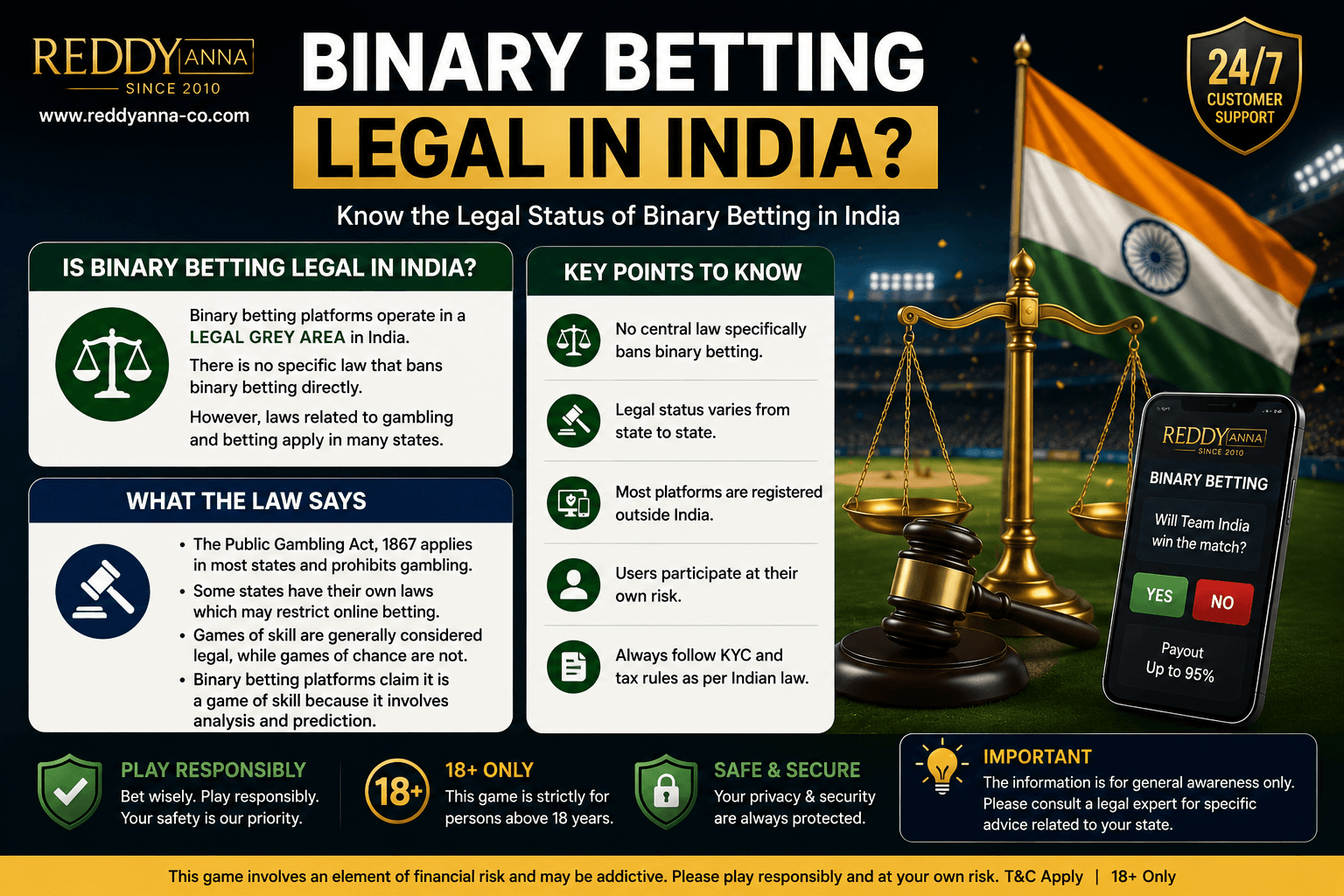
The question of binary betting legality in India 2026 is not a simple one to answer, and that’s not because the subject is obscure, but rather because India’s legal framework for betting and gambling is truly fractured across multiple laws, state jurisdictions, and regulatory bodies. What is legally illegal under one law may be in a grey area under another. What is enforced on operators is very rarely enforced on individual punters. If you want to know what the state of binary betting in India is in 2026, you can’t treat the whole framework as one rule. You have to look at each layer separately.
The Legal Framework: Indian Gambling Law and Online Binary Betting
India’s main gambling legislation is still the Public Gambling Act of 1867, a colonial-era law never replaced at the national level. The Act prohibits operating or visiting a common gaming house, a physical gambling establishment. It makes no mention of online betting, digital platforms, or any form of electronic wagering, because none of those things existed when it was written. A handful of states, such as Uttar Pradesh, Madhya Pradesh, and Punjab, have adopted the Public Gambling Act as their own state law, either in its original form or with modifications. States such as Goa and Sikkim have gone a step ahead and have enacted their own gambling laws, allowing certain forms of regulated gambling in their territory.
What this means for the binary betting online legal landscape in India: the Public Gambling Act does not mention online or offshore betting at all. Enforcement under it has historically targeted physical gambling dens and operators running establishments within India, not individual users placing bets on offshore websites from their phones. It is this mismatch between the original scope of the law and the present online betting that has allowed the foreign offshore platforms to operate in India for years without any clear legal prohibition on their users.
PROGA 2025 – The Biggest Change and How It Will Affect Online Betting in India
The biggest change in online betting laws for India in 2026 is the Promotion and Regulation of Online Gaming Act, 2025 – PROGA. The President signed the Act in August 2025, and its implementing rules, the implementing rules under PROGA, are being notified in phases, with the Act itself already in force since its Presidential assent on August 22, 2025. PROGA bans all “online money games” outright – any online game with real money wagered – and recommends harsh penalties for the operation or promotion of such platforms in India.
Under PROGA, hosting or running an online money game without a valid licence is punishable with up to 3 years imprisonment and a fine of up to one crore rupees. The punishment for repeated offences is increased to 5 years and two crore rupees. Advertising on banned platforms is punishable by up to 2 years in prison and a fine of up to ₹50 lakhs; repeat offences carry up to 3 years and ₹1 crore. The penalties are aimed at operators and platforms, not individual betters. As of May 2026, PROGA has faced industry criticism and legal challenges, though its core provisions are in force at the central level. That means that the legal landscape is moving rapidly, and the position as of this writing could change depending on how the Supreme Court rules in the next few months.
What Does Indian Gambling Law Say About Binary Trading in Particular?
Indian gambling laws for binary trading are a little more regulated than standard sports betting, as it is classified under gambling law, but also under financial regulation. In their original financial form, binary options are a bet that a currency, stock, or commodity price will be above or below a certain level at a certain time and are explicitly covered in the RBI and SEBI regulations.
The Reserve Bank of India has repeatedly issued warnings and advised against offshore forex and binary options platforms. The directions issued by the Reserve Bank of India (RBI) on electronic trading platforms, 2025, define binary options trading platforms operating without authorisation from RBI or SEBI as unauthorised electronic trading platforms. If you use it for trading involving the Indian rupee, it is a violation of FEMA. The RBI has an Alert List of unauthorised platforms and has asked banks to be alert to transactions on such platforms. Angel One’s compliance guidance explicitly lists “CFDs and Binary Options: entering into bet-like contracts lacking genuine exchange connectivity” as a major breach of FEMA.
This is different from the yes/no betting markets on cricket betting platforms that Indian punters will be more familiar with. They are structured differently from financial binary options and are under gambling law, not financial regulation. The problem is that many Indian users see both categories under the same name, as there is overlap in terminology. So the distinction is important.
What is RBI’s Prohibition on Betting Payments in India?
RBI rules on betting platforms in India largely work under FEMA - the Foreign Exchange Management Act, 1999. Outward remittances from India for the purpose of gambling, lotteries, sweepstakes, and betting are specifically prohibited under the Current Account Transaction Rules under FEMA. This technically means that moving money from an Indian bank account to an offshore betting platform is a breach of FEMA.
In practice, UPI payments to offshore platforms are processed through Indian payment intermediaries rather than as direct foreign remittances, creating what legal analysts have called a “practical grey area.” IndiaBettingHub’s 2026 legal analysis notes that “FEMA prohibits outward remittances for lotteries and other forms of betting, but UPI payments to offshore sites are processed through Indian intermediaries, creating a practical grey area.” Enforcement at the payment level has focused on operators, banks have been told to block transactions linked to specifically banned platforms rather than individual users making UPI deposits. The fact that individual users are not prosecuted does not make it legal, but it does reflect the reality of how enforcement has been applied to date.
India’s State-by-State Sports Betting Legality Outlook for 2026
The legal picture around sports betting in India becomes most uneven at the state level. Betting and gambling are a state subject under the Seventh Schedule to the Constitution of India, which means each state has the power to make its own laws. That has produced a patchwork map, with very different legal positions depending on where you happen to live.
Sikkim and Goa, the most liberal regimes, permit state-licensed gambling operations under their own laws. Sikkim allows online games such as sports prediction markets, but they are restricted to Sikkim alone. But in 2026, some states have moved to enact stricter gambling laws in 2026, with penalties exceeding the 1867 Act's provisions for running a gambling den. Most other states still adhere to the Public Gambling Act, which leaves online betting in the grey area, as the Act does not directly address it. Enforcement actions against individual bettors using offshore platforms are extremely rare across all states.
Legal Status of Online Betting in India - What does this mean for Binary Betting Users in 2026
The legal status of online betting in India for someone using a binary yes/no betting market on cricket in 2026 can be truthfully summarized as follows.
Financial binary options in currencies or commodities through unauthorized platforms violate FEMA and RBI directions and involve genuine regulatory risk. The Public Gambling Act does not directly prohibit individual use of offshore sites, the PROGA targets operators rather than individual users, and enforcement against individual bettors is almost nil in the publicly recorded case history. Offshore platforms offer yes/no cricket betting markets in a grey area.
What has changed dramatically in 2026 is the direction of travel. PROGA says the Indian government is seeking to bring online betting under tighter regulations. The Regulation of Online Gambling Rules 2026 came into force on May 1, introducing a central regulator for the first time. Payment enforcement is becoming increasingly aggressive, with banks being more proactively directed to block transactions related to specifically identified platforms. Anyone betting in India on binary or sports betting markets on offshore platforms in 2026 should know that they are operating in a legally uncertain space that is becoming more clearly defined and not in a direction that favours offshore betting.
Final Thoughts on Binary Betting Legality in India 2026
The binary betting works legal landscape for India in 2026 is not a question of yes or no, which is a little ironic for a market type based on yes or no answers. Financial binary options are definitely prohibited under FEMA and RBI directions. Online betting platforms are a category targeted by PROGA 2025 and the new Regulation of Online Gambling Rules. The individual users are using offshore cricket betting platforms in a grey area where enforcement has been minimal in the past, but the regulatory direction is towards greater restriction. The most clear practical step for anyone engaged in binary betting markets on cricket platforms is to use licensed, transparent platforms that are under verifiable international regulation and support Indian payment methods through established channels in order to mitigate legal and financial risk in 2026.