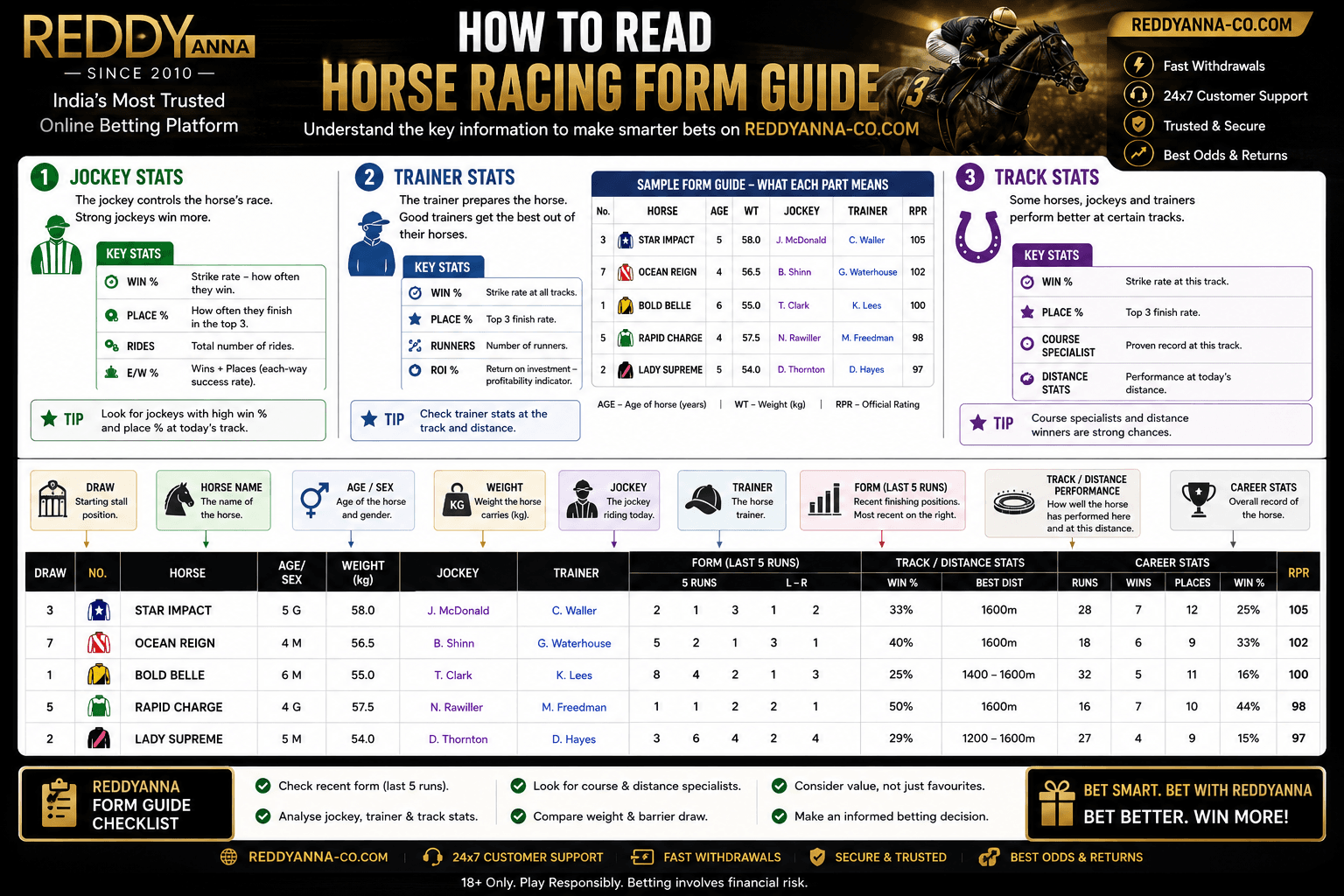
The first time most people sit down with a horse racing form guide, the reaction is usually somewhere between confusion and mild panic. The page is dense. Every horse has a block of information that looks like it was written in shorthand for people who have been going to the races for forty years. Numbers, letters, slashes, and abbreviations that seem to follow no obvious logic. There are weight figures, distance codes, going descriptions, speed ratings, and trainer percentages all crammed into a format that rewards patience and punishes impatience.
Here is what experienced racegoers know that newcomers do not: the form guide is not as complicated as it looks. Once you understand the structure and what each element is actually telling you, the density of the page starts to resolve into genuinely useful information. More than that, learning to read form properly gives you an analytical edge that bettors who pick horses based on name, color, or gut feeling will simply never have.
This guide breaks down the form guide section by section. We will cover past performance data and how to read a horse's form string, what the going and distance information tells you, how to evaluate jockey statistics in a meaningful way, what trainer stats actually reveal about a yard's current condition, how to read track-specific data intelligently, and how to synthesize all of it into a coherent picture of a race before you place a bet.
If you have ever been frustrated by a form guide and put it down, this is the piece that will make you pick it up again.
Why Form Guides Matter for Horse Racing Bettors
A form guide is a structured record of a horse's past racing performances, combined with contextual data about the upcoming race and the connections responsible for the horse. In print form, guides are published in racing newspapers. Online, they are available on official racing authority websites, dedicated racing data platforms, and increasingly integrated into the Horse race betting interfaces of major sportsbooks.
In the Indian context, bettors who follow international racing events like the Kentucky Derby, the Epsom Derby, the Melbourne Cup, or major Hong Kong and Singapore race meetings will find form guides available on dedicated international racing sites, including Racing Post, Timeform, and the official websites of major racing jurisdictions. These platforms present the same information in slightly different formats, but the underlying data points are consistent across all of them.
The form guide serves two parallel purposes. First, it gives you the history: a record of what a horse has done in the past, under what conditions, against what quality of opposition. Second, it gives you the context: who is riding, who is training, what the track is likely to be, what weight the horse is carrying, and how these current conditions compare to what the horse has experienced before.
Reading both dimensions is what separates a surface-level assessment from genuine form analysis.
Key Elements of a Horse Racing Form Guide
The most immediately visible piece of data for any horse in a form guide is the form string: a sequence of numbers and letters that summarises the horse's finishing positions in its most recent races.
A typical form string might look something like this: 2-1-4-1-3
Reading left to right, this tells you the horse's finishing positions from oldest to most recent. In this case, the horse finished second, then won, then finished fourth, then won again, then most recently finished third. The hyphen between numbers typically separates races from different meetings. Some form strings use a slash to denote the gap between seasons.
The letters that appear within form strings carry specific meanings:
F indicates the horse fell during the race. U means the horse unseated its rider. P or PU indicates the horse was pulled up by the jockey before finishing, usually due to distress or injury. R means the horse refused a fence or hurdle (in jump racing). 0 or a number higher than 9 indicates the horse finished outside the first nine places. On some formats, double-digit finishes are written as a single zero. W on some platforms denotes a win, though most use the number 1. D or Disq indicates the horse was placed but subsequently disqualified. C on some European form guides indicates a course winner, meaning the horse has previously won at this specific track. D in a different context (not disqualification) can also indicate a distance winner, meaning the horse has previously won over this specific trip.
When you look at a form string, the first thing you are assessing is basic consistency. A string of low numbers (ones, twos, threes) indicates a horse that competes near the front regularly. A string with several high numbers punctuated by the occasional win might indicate a horse that is streaky or distance-dependent. A string with P or F notations demands closer investigation into why those runs happened, whether they represent a pattern or isolated incidents.
What form strings cannot tell you on their own is the quality of the fields those positions were achieved in. A horse that finished second in five consecutive races but was beaten in a group of weak maiden races is a very different prospect from a horse that finished second in five consecutive Group 1 contests. The form string is the starting point, not the conclusion.
Performance and Race History
Alongside or embedded within the form string, form guides provide information about the class of race each run was taken from. Understanding class is fundamental to interpreting what any finishing position actually means.
Horse racing is graded by competition level across multiple systems depending on the country. In the UK and Ireland, races run from Class 1 (the highest, including Group races) down to Class 7 for the most moderate contests. In Australia, the system uses Metropolitan, Provincial, and Country grades. In the United States, stakes races, listed races, allowance races, claiming races, and maiden races represent a broad spectrum from the highest to the lowest level of competition.
When a horse drops in class from its recent runs, its form figures become more meaningful because it is now facing easier competition. When a horse rises in class, the same form figures need to be discounted because it is stepping up against superior opponents.
An experienced form reader always checks class movement first when assessing a horse's recent form string. A series of moderate finishes in high-class races might represent better form than a series of wins in low-class races, even though the numbers on the page look worse.
The race distance and going conditions attached to each run are equally critical for interpreting form properly, which brings us to one of the most important sections of any form guide.
Track Conditions (Going) and Their Impact
Every race in a horse's form guide is accompanied by the going (track condition) and the distance at which the run took place. These two variables interact with every horse's form figures in ways that make them essential to read correctly.
Going:
Going describes the firmness or softness of the track surface. The standard going descriptions vary slightly by country but broadly follow this spectrum:
In British and Irish racing: Firm, Good to Firm, Good, Good to Soft, Soft, Heavy. Firm means the ground is dry and hard. Heavy means the ground is saturated and deep. Each step along this scale changes how a race is run fundamentally. Heavy ground slows times considerably, favours horses with stamina, and often suits horses with a particular action that picks up well in deep going. Firm ground rewards speed and favours horses with a clean, efficient stride.
In Australian racing: Fast, Good, Dead, Slow, Heavy. The terminology differs, but the spectrum is analogous.
In American racing: Fast, Good, Muddy, Sloppy, Wet-Fast. Dirt tracks in America have different going descriptions from turf courses.
Why does going matter for form reading? Because a horse that produces brilliant form on good to firm ground might run an entirely different race on soft or heavy going, and vice versa. When you see a horse with seemingly contradictory form, flat performances alternating with sharp ones, going preferences are often the explanation.
The form guide will show you the going for each run in a horse's history. Your job is to identify whether the horse's best performances cluster around specific going descriptions and whether the conditions for the upcoming race match those peaks.
Distance:
Distance is measured in furlongs in the UK and Ireland (with 8 furlongs equalling 1 mile), in metres in Australia and many Asian jurisdictions, and in furlongs and fractions in the United States.
Every horse has an optimum distance range. Some horses are pure sprinters who are electrifying over five or six furlongs but fade completely when asked to stay a mile. Others are stayers whose stamina only begins to show from a mile and a half upward. Most horses sit somewhere in the middle, with a range of distances where they perform reliably and zones beyond that range where their form deteriorates.
In the form guide, checking the distance of each past run against the distance of the upcoming race tells you whether the horse has form over this specific trip or whether the upcoming race asks it to do something new. A horse stepping up in distance for the first time might have hidden stamina that makes it a potential improver, or it might find the extra ground beyond its limits. A horse returning to a trip it previously won over is operating on familiar terms.
The combination of going and distance creates a four-variable matrix for each past run: the horse's finishing position relative to the going and distance conditions on that day compared to the conditions for the upcoming race. Horses whose best runs came in conditions similar to today are significantly more reliable selections than horses whose best form came in completely different conditions.
Jockey and Trainer Statistics
The jockey is the one variable in horse racing that changes with every single race booking, and understanding what jockey statistics mean requires getting past a few common misconceptions.
The most widely cited jockey statistic is the win percentage: the proportion of rides that result in a winner over a specified period. A jockey with a 20% win rate is converting one in five rides into winners. In the context of a sport where even elite riders rarely exceed 25%, this matters.
But raw win percentage alone is an incomplete picture. Here is why.
Ride quality versus mount quality:
A jockey riding for the most powerful training yards with access to the best horses will post higher win percentages, partly because the horses themselves are superior. The same jockey on the same number of rides from a weaker yard might post a lower win percentage that actually represents better riding performance, because they are winning with less talented horses.
The most meaningful jockey statistic is not win percentage in isolation. It is a win percentage relative to expectations given the quality of rides. Advanced form guide platforms like Racing Post provide a statistic called A/E (Actual/Expected), which compares how many winners a jockey or trainer has had against the number statistically expected based on the market prices of their rides. An A/E above 1.0 means they are outperforming expectations. Below 1.0 means they are underperforming. This single number tells you far more about genuine ability than raw win percentage.
Course form for jockeys:
Just as horses have track preferences, jockeys have tracks where they consistently perform better. Some of this is familiarity, the result of riding at a particular track frequently enough to understand its specific quirks and where races tend to be won and lost. Some of it is simply that certain jockeys are retained by powerful regional yards who dominate specific tracks.
A jockey's course record is available on most form guide platforms. Before a major race, checking whether the jockey riding your selection has a strong record at the specific venue adds a meaningful data point. A jockey who has won at a particular track multiple times in the past season is operating in familiar territory. One who rarely rides there is not.
Jockey–Trainer Partnerships
One of the most reliable signals in a form guide is when a powerful trainer uses a particular jockey repeatedly on their best horses. Stable jockeys are retained by yards to ride the connections' best horses, and when a trainer who rarely uses a specific outside jockey suddenly books them for a race, it often signals genuine confidence in that horse's chances on race day.
The booking of high-profile jockeys for seemingly routine races is a well-known signal in racing circles. If a yard's usual jockey is replaced by a more senior rider, it sometimes indicates the connections expect a big run. Conversely, if a trainer's usual first-choice jockey is replaced by a lesser-known rider, it can reflect reduced expectations.
Trainer Data: Reading the Yard's Existing State
Trainer statistics are among the most underutilised data points in recreational race analysis, which makes them among the most valuable for anyone willing to look at them properly.
A horse's past form was produced under specific conditions, often with different trainers, jockeys, or in different states of physical preparation. The trainer running the horse today is the current steward of its preparation, and that trainer's current form tells you something important about how well their yard is operating right now.
Current form period statistics:
Form guides display trainer statistics across different time periods: the last 14 days, the last month, the current season, and career totals. The most relevant for bets horse racing purposes is the recent short-term period, typically 14 days to a month. A trainer whose yard is running hot right now, posting wins at a rate above their seasonal average, is more likely to have horses arriving at the track in peak condition than a trainer whose recent stats show a pronounced cold streak.
Cold streaks happen to every training yard for reasons that are not always visible from the outside. Virus going through the yard, a key staff member leaving, construction at the training facility, and a run of bad luck with injuries. The effect on the horses' condition and readiness is real even when the specific cause is not reported. Tracking trainer form over the recent period is a way to detect these yard conditions indirectly.
Trainer statistics by race type and conditions:
Advanced form guide platforms break down trainer statistics by specific variables, including distance, going, and race type. A trainer who shows a strong record with horses having their first start after a break, known as fresh runners, is a different proposition from a trainer whose record with fresh runners is poor. This variable is particularly relevant for horses returning from a layoff, a common feature of any form guide.
Similarly, some trainers show dramatically different statistics on different going conditions. A yard that consistently produces winners on soft ground but struggles on firm ground might reflect the trainer's preference for specific types of horses whose action suits that surface. Understanding these patterns helps you assess whether the conditions for a specific upcoming race align with the trainer's strengths.
Trainer win percentages by class:
Some trainers are specialists in specific classes of racing. A trainer with an outstanding record in lower-class claiming races might have a modest record in higher-class stakes races. Another trainer might show the opposite, with their best statistics at the top of the racing pyramid. Identifying where a trainer's statistics peak tells you which of their runners to take most seriously based on the class of the upcoming race.
The significance of first-time starters:
When a trainer fields a horse that has never raced before, the form guide has no past performance data to show. In this situation, trainer statistics become even more important because they are essentially your only data point on the horse itself. A trainer with a strong win rate for first-time starters running a newcomer in a maiden race deserves respect regardless of the lack of past form. Trainers who run newcomers to win rather than to give them experience tend to have identifiable statistical signatures over time.
Track Statistics: Understanding Venue-Specific Data
Horse racing tracks are not interchangeable. Each venue has specific characteristics that affect how races are run and which types of horses succeed there. Form guides include track-specific data for both horses and connections, and this information is more actionable than most casual observers realize.
Track configuration:
Some tracks are tight with sharp turns that reward horses with a nimble, balanced action and punish those who need a long sweeping bend to show their best. Others are galloping tracks with long straight sections where pure speed and stamina are tested most directly. The draw (starting position in the starting gate) interacts with track configuration in ways that dramatically affect outcomes at certain venues.
Draw bias is one of the most documented and most consistently exploitable patterns in horse racing. At some tracks, horses drawn on the outside consistently outperform those on the inside because of how the rails are positioned and how pace scenarios typically develop. At others, the inside draw is a consistent advantage. Form guides post-position data for each past run, and over a large sample of races at a specific track, consistent draw biases become visible.
Course winners:
A horse that has won at today's track has demonstrated that it handles the configuration, the surface, and the atmosphere of that specific venue. Form guides flag course winners prominently, and for good reason. The evidence base for a horse performing well at a given track is literally the result of having already performed well there. While past course form does not guarantee future course success, it eliminates the uncertainty that comes with a horse visiting a track for the first time.
Stance at the course:
A horse might have course form but over a different distance from today's race. The form guide breaks this down with specific course and distance statistics, showing records at this specific track over this specific trip. A horse that has won at today's course and today's distance, in conditions similar to today's going, is operating on maximally familiar terms. That kind of alignment across multiple variables is genuinely meaningful.
Weight and Handicap Factors:
In handicap races, horses carry different weights assigned by the official to equalise chances across the field. Understanding how weight relates to form is an important piece of the picture.
Higher-weighted horses in a handicap have been assigned that weight because their past performances indicate superior ability. Carrying more weight is theoretically a disadvantage, but it also identifies a horse the handicapper believes is better than its rivals. The question is whether the weight assignment accurately reflects the current ability gap or whether there is a horse in the field whose handicap mark is below its actual current ability.
Horses who have recently improved significantly, particularly three-year-olds still maturing during the season, often carry a handicap mark based on slightly older form that does not yet reflect their current level. Spotting these improvers before the handicapper catches up to their true rating is one of the most reliably profitable skills in handicap racing.
The form guide shows the weight carried in each past run. Comparing the weight carried historically against today's weight tells you whether the horse is running off a higher or lower mark than it has previously shown form from. A horse running off a career-low handicap mark following a series of moderate runs might represent a live bet if there are signs its current form is returning.
Understanding Odds in Horse Racing Form Guides
With all of the individual components covered, here is a structured sequence for reading a form guide that brings the data points together in a practical order.
Start with the form string. Get a basic impression of recency and consistency. Are there pattern runs, a horse that consistently finishes second? Signs of a return to form after a quiet patch? Unfinished business in the form of a string (letters like P or needs that need explaining? Move to class and conditions for each run. Are the best performances coming at today's class level or above it? Do the best runs match today's going and distance?
Check the trainer's recent form. Is the yard running hot or cold over the last two weeks? Does the trainer have a strong record with this specific horse type, class level, and conditions?
Assess the jockey booking. Is this a regular partnership between trainer and jockey, suggesting stable confidence in the horse? Does the jockey have good course form? Has there been a significant jockey change from the horse's recent runs?
Look at the course and distance record. Has the horse won or placed here before? Over today's specific trip?
Review the draw. What is today's post position, and what does the draw record at this
Track tells you whether that position is advantageous or not?
Consider weight in handicap races. Is the horse running off an attractive or unattractive mark relative to its demonstrated form?
Only after working through all of these layers do you arrive at a genuine opinion about a horse's chances. That opinion, formed from multiple data points rather than a single impression, is worth considerably more than a gut feeling or a pick based on name recognition.
How to Use Form Guides for Better Betting Decisions
One of the things that separates consistent form analysts from occasional bettors is that they read form guides regularly, not just on days when they are online betting. Following how a horse's form evolves across several races, watching how a trainer's statistics move through the season, tracking how specific jockeys perform at different tracks through a campaign, all of this builds a contextual knowledge base that makes individual race analysis considerably faster and more reliable.
Racing Post, Timeform, and the official racing authority websites for major jurisdictions are all excellent sources for the kind of ongoing form study that builds this knowledge over time. The investment of an hour a week on a non-race day, reviewing the form of horses you followed in recent racing, produces significant compound returns in the quality of your analysis over a single racing season.
The form guide is not a static document you pick up immediately before a race and put down again. It is a living record of a sport that rewards knowledge accumulation above almost everything else. The racegoers and bettors who find consistent value are not the ones with the sharpest instincts at the moment. They are the ones who have been doing the reading long enough that the instincts themselves are built on genuine foundations.
Final Thoughts: Mastering Horse Racing Form for Smarter Bets
Reading form is a skill that takes time to develop and even longer to master. The first form guide you pick up will have unclear sections. The second will be clearer. By the twentieth, the structure will feel natural, and the information will start to flow in a way that produces genuine analytical conclusions rather than just a vague impression.
The jockey data tells you who is operating with confidence right now and who understands this track. The trainer statistics tell you whether the yard preparing your selection is currently producing fit, well-conditioned horses ready to run their best. The track data tells you how the specific venue rewards specific types of horses and whether today's conditions suit your selection's profile.
None of it is a guarantee. Horse racing is genuinely uncertain, which is both its appeal and the source of its occasional frustration. But the bettor who reads the form guide properly is making decisions on the basis of actual evidence rather than hoping their intuition is better than everyone else's.
It usually is not. The form guide often is.