Horse racing has this reputation for being complicated. You walk up to a race, look at the betting menu, and suddenly you are staring at a wall of terms: exacta, quinella, trifecta, superfecta, daily double, pick four, and pick six. Then there are the odds displayed in fractional format that nobody explained to you. And the program with past performance data that looks like a spreadsheet designed by someone who genuinely hates beginners.
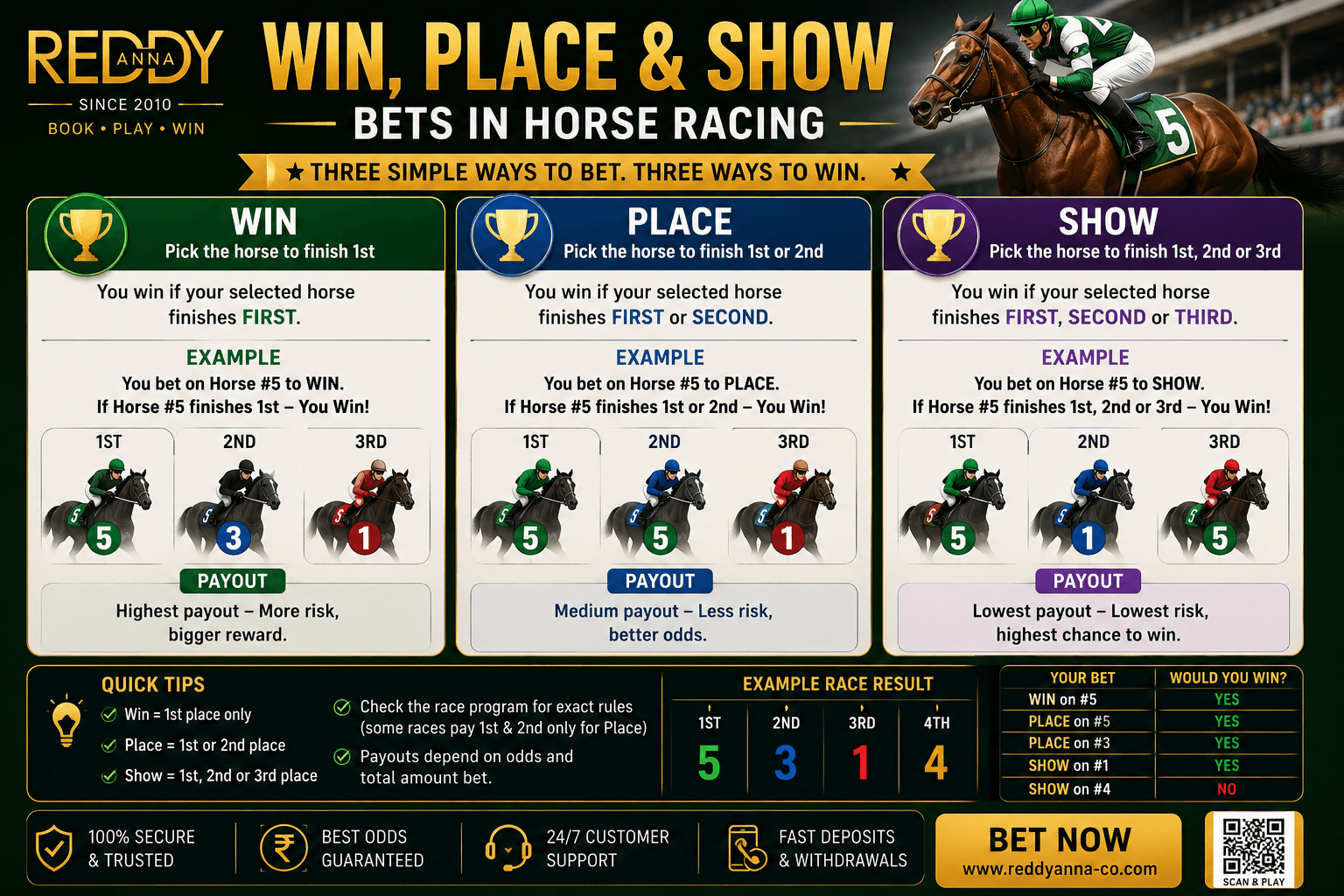
Here is the thing, though. Underneath all of that complexity, horse racing betting starts with three genuinely simple bets. Win, Place, and Show. If you understand these three, you understand the foundation that everything else in horse racing wagering is built on. The exotic bets, the multi-race wagers, the complex combination tickets — they are all variations or combinations of these fundamental concepts.
This guide is written specifically for people who are new to horse racing betting and want to understand it properly, rather than just place random bets and hope for the best. We are going to go through each of the three basic bet types in depth, explain what they mean, show you how the math works, discuss when each one makes sense strategically, and then look at how these bets behave differently depending on whether you are betting on a fixed-odds sportsbook or in a pari-mutuel pool.
By the end, the basic online betting menu at any horse racing event will make complete sense. And that clarity is genuinely the most important foundation for betting on horses with any degree of intelligence.
Why Horse Racing Betting Is Different from Other Sports
Before getting into the specific bet types, it is worth spending a moment on one aspect of horse racing betting that catches beginners off guard: the pari-mutuel system.
In most sports betting, you are betting against the bookmaker. The bookmaker sets a price, you accept it, and if your selection is correct, you receive that fixed return regardless of what anyone else bets. This is called fixed-odds betting, and it is the format most Indian bettors are familiar with from cricket and football betting platforms.
Horse racing, particularly at the track and on official racing platforms, typically uses a pari-mutuel system instead. In pari-mutuel wagering, you are not betting against the bookmaker. You are betting into a pool shared with every other bettor on the same wager type at that track. The track takes its cut, which is called the takeout (typically between 15% and 25% depending on the wager type and the jurisdiction), and the remaining money in the pool is divided among all winning ticket holders.
This means the odds you see displayed before the race are not fixed. They are estimates based on the current distribution of money in the pool. As more money comes in, the odds shift. The final odds, called the official odds, are determined only when betting closes at the start of the race.
Why does this matter for understanding Win, Place, and Show bets? Because each of these three bet types has its own separate pool of money. The Win pool, the Place pool, and the Show pool are independent of each other. A horse that attracts heavy Win betting might have distorted Place and Show pool prices. Understanding this pooling structure helps you make smarter decisions about which bet type offers better value on any given selection.
Many online sportsbooks that accept bets on major international races, including Indian-facing platforms that carry events like the Indian derby 2026 betting, Epsom Derby, and major Australian racing, offer fixed-odds markets alongside pari-mutuel options. In fixed-odds markets, the Win, Place, and Show concepts still apply in spirit, though they may be labeled differently. An "each-way" bet on a European sportsbook is essentially a combined Win and Place bet, which we will cover in detail.
Understanding the Pari‑Mutuel System vs Fixed Odds
The Win bet is the most straightforward wager in horse racing. You pick a horse. If that horse crosses the finish line in first place, you win. If it finishes anywhere else, you lose. There is no partial credit, no consolation prize for second place, no safety net. First place only.
In a pari-mutuel pool, your return depends on how much money is in the Win pool and how much of it was bet on your horse. The more money bet on your horse relative to the total pool, the lower your return. The less money bet on your horse, the higher your return. This is why longshots at high odds produce large payouts when they win. The public did not back them heavily, so the pool is distributed across fewer winning tickets.
In fixed-odds betting, your Win bet returns whatever price you accepted at the time of placing, multiplied by your stake. If you back a horse at 8-1 and it wins, a 1,000-rupee Win bet returns 9,000 rupees: 8,000 in profit plus your 1,000 stake back.
Win Bet Explained: Straightforward Betting Strategy
The Win bet is the right choice when you have a strong conviction about a specific horse finishing first, and you want the maximum possible return from that conviction. If you have done genuine research, identified a horse you believe is priced too generously relative to its actual chances, and you want to capture the full value of that opinion, a straight Win bet gives you the cleanest expression of your view.
The Win bet also makes sense when you are backing a genuine short-priced favourite where the Place and Show returns would be negligibly small. If a horse is priced at 1.30 to win, the Place and Show returns on that horse will be even smaller fractions of that already modest price. At very short odds, the Win bet is the only format that produces a meaningful return on the bet.
Limitations of Win Bets
Horse racing is genuinely unpredictable. Even the most dominant favourite in a well-researched race gets beaten sometimes. The Win bet concentrates your entire stake on a single outcome, first place specifically, which means a horse that runs a brilliant second still results in a losing ticket. For bettors new to horse racing who have not yet developed a feel for the sport's variance, starting with Place or each-way bets allows you to learn the game while retaining a safety valve on your stake.
Place Bet Explained: Safer Betting Option
A Place bet is won when your horse finishes in one of the placed positions. What counts as a placed position depends on the size of the field:
In a race with five to seven runners, Place typically pays on first and second only. In a race with eight or more runners, Place typically pays on first, second, and third. In fields of sixteen or more horses, some betting formats extend Place terms to four positions.
The payout on a Place bet is smaller than a Win bet on the same horse because more outcomes qualify as winning results. The Place pool is independent of the Win pool, so the odds you receive for a Place bet are calculated separately from the Win price.
In practical terms, a horse priced at 10-1 to win might be priced at roughly 3-1 to place. The place price is lower because the probability of the horse finishing in the top three is considerably higher than the probability of it winning outright.
The Place bet in pari-mutuel wagering:
In a pari-mutuel system, the Place pool is split between the horses that finish first and second (or first, second, and third in larger fields). The total Place pool, minus the track's takeout, is divided equally among all qualifying finishing positions and then distributed to winning ticket holders in each of those positions. This means that in a race where a heavily backed favourite finishes second, the Place pool payout might be modest because a lot of money was also bet on the winner. In a race where two longshots fill the top two places, Place payouts can be surprisingly generous.
When the Place bet makes sense:
The Place bet is well-suited for situations where you are confident a horse will run competitively and finish near the front, but you are less certain it will win. This might be because the race has a strong favourite who might just beat your selection for first, but your selection is clearly the second-best horse in the field. A Place bet in that scenario extracts value from your research without requiring you to bet against a genuinely superior opponent.
Place bets are also useful when backing horses at long odds, where the uncertainty is higher. A 20-1 shot that you believe genuinely has a chance of winning likely has an even stronger case for finishing in the top three. A Place bet on that horse at perhaps 6-1 or 7-1 captures a meaningful return from your research even in the scenario where the horse runs its best race but encounters better on the day.
The Show Bet: The Safety Net of Horse Racing
The show bet is the most forgiving of the three basic wager types. A Show bet wins if your horse finishes in the first three positions. In larger fields (typically twelve or more horses), the show is essentially asking whether your selection can manage a top-three finish among its competitors.
The tradeoff, predictably, is the payout. Because the qualifying range is the widest of the three bet types, show odds are the smallest. A horse priced at 10-1 to win and 3-1 to place might be priced at roughly 1-1 or even lower to show, depending on the field and the betting distribution in the pool.
In pari-mutuel terms, the Show pool is divided three ways (between the first, second, and third-place finishers), which means each winning ticket holder receives a smaller share of the pool than in the Win or Place pools. Heavy favorites who attract large amounts of show betting can sometimes produce payouts that barely return the original stake, a phenomenon called a "minus show pool" or "breakage issue" in some pari-mutuel structures.
When the show bet makes sense:
The show bet is the right choice for genuinely uncertain races with large, competitive fields where simply landing a horse in the top three is the achievable target. It is also useful as a hedging tool. If you have placed a Win or Place bet on a horse and you want to guarantee some return regardless of where the horse finishes in the top three, adding a Show bet on the same horse creates a coverage structure across multiple outcomes.
For beginners specifically, the Show bet is an excellent starting point because it keeps you in the action of the race without requiring pinpoint accuracy about the exact finishing position. Watching a race while having a show bet active teaches you how races develop, how horses position themselves, and what pace scenarios look like in practice. That education is valuable regardless of whether you collect on the ticket.
The show bet's weakness is its ceiling. Because the returns are modest by design, showing betting as a long-term strategy is difficult to make profitable. The takeout on show pools combined with the inherently low odds of showing (particularly for horses that the public has heavily backed) makes it hard to generate meaningful returns. Show bets are best used tactically for specific races and specific horses rather than as a blanket approach to all race wagering.
The Each-Way Bet: Win and Place in One Ticket
If you have bet on horse racing through a European or Australian sportsbook, you have likely encountered the each-way bet. It is not a separate bet type from Win and Place. It is a combined bet that places equal stakes on both simultaneously.
When you place a 1,000-rupee each-way bet, you are actually placing two separate 1,000-rupee bets: one on the horse to Win and one on the horse to Place. Your total outlay is 2,000 rupees. If the horse wins, both bets are collected. If the horse places but does not win, only the place portion collects. If the horse does not place, both portions lose.
The place terms for each-way betting on fixed-odds sportsbooks are typically expressed as a fraction of the win odds. Common structures are the following:
One-quarter the Win odds for place in fields of eight or more runners. One-fifth the Win odds for place in large fields or high-profile races with many runners. One-third the Win odds in smaller fields.
Using concrete numbers: a horse available at 20-1 win odds on a sportsbook offering each-way terms of one-quarter odds to three places. Your each-way bet at 1,000 rupees per part (total 2,000 rupees outlay):
If the horse wins: Win portion returns 21,000 rupees (20-1 plus stake) and Place portion returns 6,000 rupees (5-1, which is one-quarter of 20, plus stake). Total return: 27,000 rupees on 2,000 rupees staked.
If the horse places but does not win, only the Place portion returns. Win portion loses (1,000 rupees gone). The place portion returns 6,000 rupees. Net return: 5,000 rupees on 2,000 rupees staked, which is a 3,000 rupee profit.
If the horse does not place, both portions lose. 2,000 rupees gone.
This structure makes each-way betting particularly attractive for longshots in competitive fields. A horse priced at 16-1 or higher, where you have genuine confidence in a placed finish but uncertainty about whether it can win outright, is a natural each-way candidate. The each-way format lets you extract value from both outcomes without requiring the full win.
Reading the Odds: Fractional vs. Decimal for Horse Racing
Horse racing traditionally displays odds in fractional format, and if you are used to decimal odds from cricket or football betting platforms, the adjustment takes a moment but is straightforward.
Fractional odds like 5-1, 10-1, and 7-2 are read as: for every unit shown on the right, you receive the unit shown on the left as profit, plus your stake back. So:
5-1 means 5 rupees profit per 1 rupee staked. A 1,000-rupee bet returns 6,000 rupees (5,000 profit plus 1,000 stake). 10-1 means 10 rupees profit per 1 rupee staked. A 1,000-rupee bet returns 11,000 rupees. 7-2 means 7 rupees profit per 2 rupees staked, or 3.5 rupees per rupee. A 1,000-rupee bet returns 4,500 rupees. Evens (also written 1-1) means you profit exactly what you stake. A 1,000-rupee bet returns 2,000 rupees.
Converting a fraction to a decimal is simple: divide the left number by the right number and add 1. So 5-1 becomes (5/1) + 1 = 6.00 in decimal. 7-2 becomes (7/2) + 1 = 4.50. Evens becomes (1/1) + 1 = 2.00.
Odds-on horses, those priced below evens, are expressed with the larger number on the right. A 1-2 shot means you stake 2 to win 1, so a 1,000-rupee bet returns 1,500 rupees (500 profit plus 1,000 stake). In decimal, 1-2 is 1.50.
For Win, Place, and Show betting purposes, the odds you see displayed for a horse in the Win market are not the same as what you will receive for a Place or Show bet. Place and Show prices are lower by definition, and in pari-mutuel pools, they are calculated from their own separate pools rather than derived from the Win price. On fixed-odds sportsbooks, Place prices are typically quoted alongside the Win price as a separate line.
Strategic Approach to Win, Place, and Show Bets
Now that the three bet types are clear, the question becomes when to use each one and how to think about your selections before you place any money.
The research foundation:
Regardless of whether you are betting Win, Place, or Show, the information that shapes your selection is the same. You are looking at past performance data, understanding the horse's preferred running style (front-runner, mid-pack, closer), assessing how the horse has performed at similar distances and track conditions, considering the trainer's record at this specific venue, evaluating the jockey's competence and familiarity with the horse, and understanding the field composition well enough to assess whether your selection is likely to encounter a competitive pace scenario that suits its style.
For complete beginners, this research process can feel overwhelming. The practical starting point is to focus on one or two things you can actually assess rather than trying to evaluate everything at once. For new bettors, trainer record and recent form in comparable races are the two factors most accessible to research and most reliably meaningful.
Matching bet type to confidence level:
Your bet type should reflect your confidence in the specific outcome you are betting on. If your research has produced a genuine conviction that a horse will win, a Win bet captures the maximum return from that conviction. If your research tells you a horse is likely to run well and finish near the front without being certain of first place, a Place or each-way bet is the more honest expression of your assessment. If you are genuinely uncertain but think a horse is competitive in a large field, Show gives you the widest coverage for the lowest return.
This sounds straightforward, but it requires honesty with yourself. Many bettors back a horse each-way when they actually think it will win, simply to reduce the stress of watching. That is a fine personal choice, but recognise it as a variance management decision rather than a value optimisation one. If you genuinely believe a horse will win at a price that represents value, the each-way bet reduces your return on the win portion while adding modest coverage. In strictly mathematical terms, if your Win conviction is strong enough, the each-way structure dilutes the value you have identified.
Field size and bet type selection:
The relationship between field size and bet type is worth understanding clearly. In small fields of five or fewer horses, Place terms often only extend to two positions, which makes Place betting less valuable because the probability of finishing second is already reasonably high even for weaker horses. Show terms might only extend to two or three positions in small fields, which reduces the coverage advantage significantly.
In large fields of twelve or more runners, the gap between Win probability and Place/Show probability widens considerably. A horse with a 10% chance of winning (roughly 9-1 odds) in a field of sixteen has perhaps a 30% to 35% chance of finishing in the top three. That difference in probability is not always fully reflected in the Show odds, particularly for horses the public is underestimating. Finding these situations, where the Show or Place price represents a better value than the Win price for a specific horse, is a genuine skill that comes with experience in reading horse racing markets.
Common Beginner Mistakes in Win, Place, and Show Betting
Five years of writing about horse racing betting in India 2026 has produced a clear picture of where new bettors go wrong most consistently. These mistakes are worth knowing before they cost you money.
Always betting each-way regardless of odds:
Each-way betting is an excellent tool for the right situations, specifically for longshots in competitive fields where a placed finish represents genuine value. It is not a universal approach that should be applied to every selection regardless of price. Backing a 1.50 favourite each-way means placing one bet at essentially no return (the Place odds on a short favourite might be 1.10 or 1.15) alongside your Win bet. The each-way structure adds cost without adding meaningful value at short odds.
Ignoring field size when assessing Place and Show bets:
A Show bet in a six-horse race covers three of the six runners. You are essentially betting on a coin flip between placed and unplaced horses. In a sixteen-horse race, the same Show bet covers three of sixteen runners, which is a much more discriminating selection. The value of Place and Show bets is inherently tied to field size, and bettors who do not adjust their thinking based on how many horses are running will consistently misjudge the meaning of the odds.
Chasing losses by switching bet types:
A common pattern is to back a horse into Win, it runs second, and the frustration of near-missing prompts a switch to Place betting on the next race to avoid the same disappointment. This reactive approach means your best type is being determined by the emotional aftermath of the previous race rather than by a genuine analysis of the current one. Every race and every bet decision should stand independently on its own merits.
Not understanding the pari-mutuel pool structure:
In pari-mutuel wagering, heavy Show betting on a popular favourite can result in a Show payout that barely returns your stake, even when the horse finishes in the top three. This happens because so many bettors backed the same horse in the Show pool that each winning ticket holder receives a tiny fraction of the already-reduced pool. New bettors sometimes discover this unpleasant feature of pari-mutuel Show betting after the fact. On fixed-odds platforms, this dynamic does not apply because your return is fixed at placement time.
Exacta, Trifecta, Superfecta
Even the most carefully researched Win bet at short odds loses more often than new bettors intuitively expect. A horse priced at 2-1 has an implied win probability of approximately 33% before the bookmaker's margin is factored in. Two out of every three bets at those odds lose by definition. Approaching each bet with the expectation that it should win, and treating losses as anomalies, is a cognitive error that leads to poor bankroll management and emotional decision-making. Every bet type, including Show bets on strong favourites, loses regularly. Building that expectation into your approach is essential for longevity in horse racing betting.
Daily Double and Pick Bets
Once you are comfortable with the three basic bet types and have a feel for how race dynamics affect which option makes sense in different situations, the exotic bets become accessible rather than overwhelming.
The Exacta asks you to pick the first two finishers in the correct order. The Trifecta adds a third horse. The Superfecta adds a fourth. These bets produce much larger payouts than straight Win, Place, or Show bets because they require greater precision, but the foundation for picking the horses is the same research process you use for the basic bets. You are still assessing each horse's likelihood of running well. The only difference is that you are assessing several horses simultaneously rather than one.
Daily Double and Pick Three bets extend across multiple consecutive races, requiring you to pick winners in two or three races in a row. These multi-race bets are engaging because they sustain interest across an entire race card rather than resolving in a single event. But they are firmly in advanced territory. Developing reliable Win bet judgment in individual races is the prerequisite for multi-race wagering.
The progression from beginner to intermediate horse racing bettor runs through Win, Place, and Show. Not because these bets are as simple as a permanent destination, but because understanding them deeply, understanding the pools, the odds structures, the field size effects, and the strategic matching of bet type to confidence level, gives you the analytical vocabulary for everything more complex.
Practical Tips for New Horse Racing Bettors
If you are placing your first horse racing bets, here is a practical framework for the opening sessions:
Choose races with larger fields of ten or more horses. The odds structures are more interesting, and the research process is more informative.
Start with Place or each-way bets rather than straight Win bets. The additional coverage lets you learn what it feels like to have a horse run well and still collect, which is an important experience for calibrating your confidence levels.
Set a session budget and stick to it. Horse racing involves several races in sequence, which creates a natural pressure to keep betting through a card. Decide in advance how many races you will engage with and what your per-race stake is.
Keep notes on why you backed each horse. After the race, review whether your reasoning was correct regardless of whether the bet won. A bet can win for the wrong reasons and lose for the right ones. Building a habit of reviewing your reasoning rather than just your results produces better decision-making over time.
Start with one race meeting rather than spreading your attention across multiple tracks simultaneously. The depth of understanding you gain from following a single meeting closely is more valuable than the shallow exposure of monitoring five at once.
Final Thoughts: Building a Strong Betting Foundation
"Win," "place," and "show" are the vocabulary of horse racing betting. They are not simple in the sense of being trivial or unimportant. They are simple in the sense of being fundamental, the concepts every other horse racing wager is built from, and the decisions that teach you to read a race, assess a horse, and understand the market you are betting into.
Rushing past them to reach the more complex and lucrative exotic bets before you genuinely understand the basics is the most common mistake new horse racing bettors make. It produces confusion, poor decisions, and losses that feel mysterious because the underlying mechanics were never properly understood.
Take the time to know these three bets well. Place a hundred of them across different races, different field sizes, different track conditions, and different confidence levels. By the end of that process, the rest of the betting menu will make sense, not because someone explained it, but because you have built the foundation it sits on through real experience.
The horse racing betting world is deep, engaging, and genuinely rewarding for people who approach it with patience and curiosity. It starts here.